
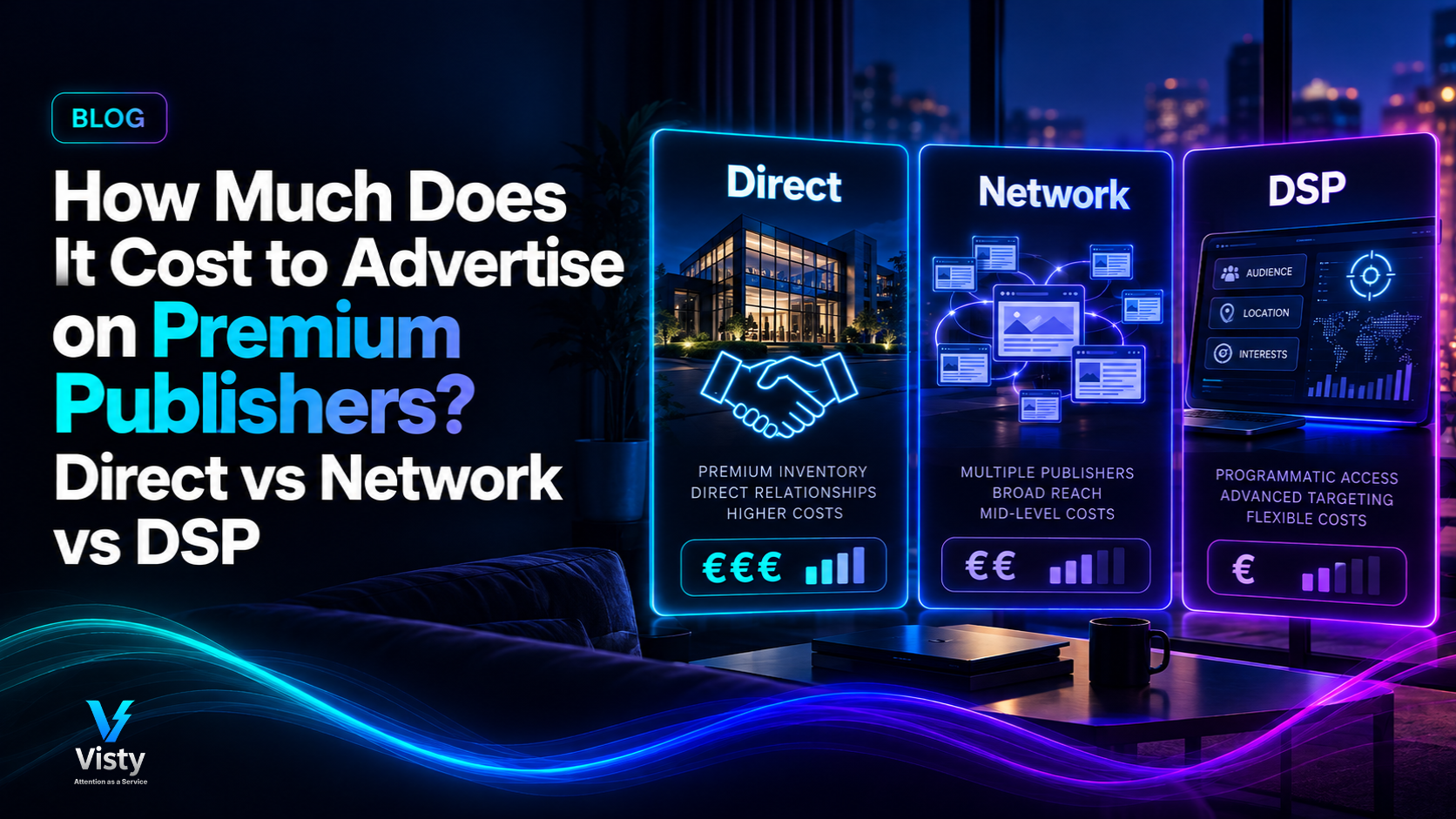
How Much Does It Cost to Advertise on Premium Publishers? Direct vs Network vs DSP (2026)
Book a 20-minute call to see what your audience costs to reach on premium publishers.
In this guide: the quick answer, the three ways to buy, what one B2B buyer was actually quoted, why publishers set high minimums, when going direct is the right call, how a premium publisher network works, where DSPs fit, running the numbers, the hybrid play, proof, and FAQs.
The quick answer
Premium publishers like the Wall Street Journal, Forbes and Business Insider rarely publish rate cards. Go direct and you get a custom quote from a sales team, and for B2B video and demand-gen programmes that quote tends to come with a minimum spend and a fixed term.
How big? In October 2026, a US B2B cybersecurity SaaS company I spoke with was quoted a $60,000 monthly minimum on a six-month term by one publisher's demand-gen team. That's $360,000 committed before a single view is delivered.
There are two other routes. A DSP gives you programmatic access to publisher inventory, but managed and enterprise tiers carry their own minimums and fees. A premium publisher network like VISTY bundles 25 to 30 top business publishers into one buy, priced per completed video view: £0.05 per completed view, starting at £1,000 a month for 20,000 completed views, with no lock-in.
The three ways to buy premium publisher video
If you want your B2B video in front of CTOs, CIOs and finance leaders while they read the business press, you have three doors:
- A premium publisher network (VISTY). One buy across a curated list of top business and tech publishers, priced on completed views, fully managed.
- Direct with the publisher. Negotiate a package with one publisher's sales team. Maximum control over that one site, maximum minimums.
- A DSP. Buy the inventory programmatically yourself, or through a managed service. Flexible, but the quality depends entirely on how it is set up.
None of these is wrong. They suit different budgets, teams and goals. The rest of this guide is about matching the route to the brand.
What a B2B buyer was actually quoted
The cybersecurity company above is a good example of where a lot of mid-market B2B brands are right now. They had a mature in-house video cadence, funny, exec-focused videos that people actually watched on YouTube. They wanted those videos in front of senior decision-makers on top business sites.
So they took the meeting with a publisher's demand-gen team. The ask was a $60,000 monthly minimum for six months. When they pushed back, they were offered a lighter custom package to keep them on the account, and the delivery on it was thin. The reporting they got back was impressions and clicks. That was it.
The person leading their evaluation summed it up better than I could: "I'm not trying to buy a Porsche."
That is the gap this page is about. The audience is on those sites. The budget to reach them is not $360,000.
Why publishers set high minimums (and why that is fair)
This is not a pop at publishers. A direct deal is expensive to deliver. There is a dedicated sales team, custom packages, sponsorships and editorial integrations, guaranteed delivery on scarce video inventory, and account management on top. Minimums are how big organisations make that cost of sale work.
The issue is fit. A minimum built around enterprise budgets prices out most Series A B2B SaaS companies and growing DTC brands before the conversation starts. That is why I built VISTY the way I did: to give brands of all sizes access to the same premium inventory, without the enterprise entry ticket.
When going direct is the right call
Honest answer: sometimes it is. Go direct when:
- The site you need only sells direct. Some publishers only work direct with advertisers. No network can buy them, VISTY included.
- You want more than video ads. Sponsorships, homepage takeovers, custom content, events and editorial partnerships are direct-only products.
- One publisher's audience is the whole strategy and your budget covers the minimum comfortably.
If none of those apply and the goal is getting your video watched by the right people across the premium business press, a network will usually get you further for the money.
How a premium publisher network works
Here is exactly how a VISTY campaign is built, in the order it happens.
1. Audience first
We build the audience before anything runs. For US campaigns that means B2B data segments from suppliers like Dun & Bradstreet and Bombora, cut by company size, industry and job function: CTOs, CIOs, CISOs, VPs of IT, finance leaders and so on. We layer in your competitor and category keywords too. You agree all of it before launch. More on this in our guide to reaching senior decision-makers on premium publishers.
2. The premium publisher network
The B2B premium publisher network covers 25 to 30 business and tech publishers, including Forbes, Fortune, Business Insider, the Wall Street Journal, Bloomberg, Reuters, CNBC, the Financial Times, The Economist, the New York Times, TechCrunch, VentureBeat and ZDNet. Your ads run only on the sites on the agreed list. No junk sites, no made-for-advertising inventory.
3. Only the formats people watch
This is the bit most buys ignore. Within video, some formats are just cheap reach that pads margin. So in-stream runs as pre-roll and mid-roll only, and post-roll is cut entirely because nobody hangs around after the video they came for. Out-stream runs in medium and large in-feed players only. In-banner video, the little box nobody watches, is cut too.
4. Flat, simple pricing
$0.05 per completed view. £1,000 gets you 20,000 completed views, and every extra £1,000 adds another 20,000. Most B2B tech companies start at £3,000 to £5,000 a month. No long-term contract, pause or cancel monthly. Why completed views and not impressions? Read why CPM is a broken model.
5. Reporting with nothing to hide
Because it is a fixed list of sites, you get the full delivery report, not the usual top five: impressions, completed views, completion rate, clicks and CTR by website, plus quartiles and screen grabs of your ads live. After about a month, audience reports show how well you reached your target roles versus the wider category. What you will not get is individual-level identity. Nobody can honestly give you that on the open web.
Book a 20-minute call to see what your audience costs to reach on premium publishers.
Where DSPs fit
A DSP is the third door. Self-serve platforms can start small, but managed and enterprise DSPs are often quoted at four- to five-figure monthly minimums in 2026 industry roundups, before platform, data and service fees.
The bigger cost is waste. The ANA found that only 36 cents of every dollar entering a DSP reaches a real consumer. Without tight allowlists, budget drifts to cheap formats and junk sites.
I learned this the hard way recently. Rushing a small test campaign for VISTY's own ads, I forgot to remove the global allowlist setting. A couple of hours later the impressions were way too high, and the delivery report showed why: fantasy name generators and sites I had never heard of. Exactly the inventory a premium publisher network exists to cut out.
DSPs are powerful in the right hands. If you have an in-house programmatic team and supply-path expertise, use one. Most mid-market teams do not, and should not have to.
Running the numbers
Take the quote above: $60,000 a month for six months, $360,000 committed. (US Based Client)
The same six months on VISTY at £5,000 a month is £30,000, which buys 600,000 completed views, 100,000 a month, across the premium business press, targeted to your audience.
It is not apples to apples. A direct package can include sponsorship, custom content and a named publisher's homepage, and that has value. But if the goal is getting your video watched to the end by the right execs on top business sites, the gap is hard to ignore.
The hybrid play
You do not have to pick one door. If a direct relationship matters to you, negotiate the minimum down, say from £60,000 to £30,000, then put £10,000 to £15,000 into a premium publisher network to cover the rest of the business press. You keep the flagship relationship and add reach across 25 to 30 publishers for a fraction of the difference.
Why trust VISTY
Proof beats promises. A cybersecurity SaaS client wanted to reach IT and security decision-makers at organisations of 500 to 10,000 employees in the US. The campaign delivered 60,000+ completed views across publishers including the Wall Street Journal, Business Insider and Forbes, and indexed 2.2x for CTOs and 3.2x for CIOs versus standard category targeting. Read the full B2B campaign case study. This client has since scaled to also target the UK, Ireland, Germany and Australia.
Comparing platforms more broadly? See our roundup of the best video advertising platforms for B2B SaaS, or how we stack up in VISTY vs Teads. If you are weighing social instead, read LinkedIn video vs premium publisher video for B2B.
FAQs
How much does it cost to advertise on premium publishers like Forbes or the Wall Street Journal?
It depends on how you buy. Direct deals are custom-quoted and rate cards are rarely published, and B2B video and demand-gen packages tend to be quoted with a minimum spend and a fixed term. Through a premium publisher network like VISTY, you pay a flat price per completed video view across 25 to 30 top business publishers, starting at 20,000 completed views a month with no long-term contract.
Why do premium publishers ask for high minimum spends?
Direct deals carry a real cost of sale: a dedicated sales team, custom packages, sponsorships and guaranteed delivery on limited video inventory. Minimums make that model work for the publisher. The problem is fit, not fairness - a minimum built for enterprise budgets prices most mid-market B2B brands out.
Can I advertise on premium publishers without a minimum commitment?
Yes. VISTY campaigns start at 20,000 completed views a month, priced per completed view, and can be paused or cancelled monthly. Most B2B tech companies start at around 60,000 to 100,000 completed views a month and scale from there. Book a 20-minute call to size your audience.
Can I choose which publishers my ads run on?
You agree the publisher list before launch, and your ads only run on the sites on that list. VISTY's B2B premium publisher network covers 25 to 30 business and tech publishers, including Forbes, Business Insider, the Wall Street Journal, Bloomberg, Reuters and TechCrunch. Delivery is spread across the list based on where your audience is reading.
What if the publisher I want only sells direct?
Some publishers only work direct with advertisers, and no network can buy them. If one specific site is essential, go direct for that site. If you want reach across the wider premium business press, a network covers the rest, and splitting budget between the two often stretches it furthest.
What reporting do I get?
A full delivery report broken down by website: impressions, completed views, completion rate, clicks and click-through rate, plus completion quartiles and screen grabs of your ads live. Once enough data builds up, usually after about a month, you also get audience reports showing how well the campaign reached your target roles and seniority versus the wider category.
Can you tell me exactly who saw my ad?
No. On the open web, reporting works at audience and cohort level, not individual level. You can see that you reached CTOs and CIOs at companies in your target size band, but not which named person watched. Anyone promising individual-level identity on open-web video deserves some hard questions.
How long should I run a campaign before judging it?
Give it three months. Audience data needs time to build before the reporting is meaningful. There is no commitment to those three months though - you can pause or cancel after any month.
Is buying through a DSP cheaper than going direct?
Not always. Self-serve DSPs can start small, but managed and enterprise DSPs often carry four- and five-figure monthly minimums, and the ANA has found that only 36 cents of every dollar entering a DSP reaches a real consumer. DSPs suit teams with in-house programmatic and supply-path expertise.
Book a 20-minute call to see what your audience costs to reach on premium publishers.
This is Attention as a Service. This is VISTY.
Visibility. Done Simple.
Last Updated: 10th Nov 2026
