.png)
Why Premium Publisher Video Advertising Outperforms Social: The Data Marketers Need in 2026
TL;DR
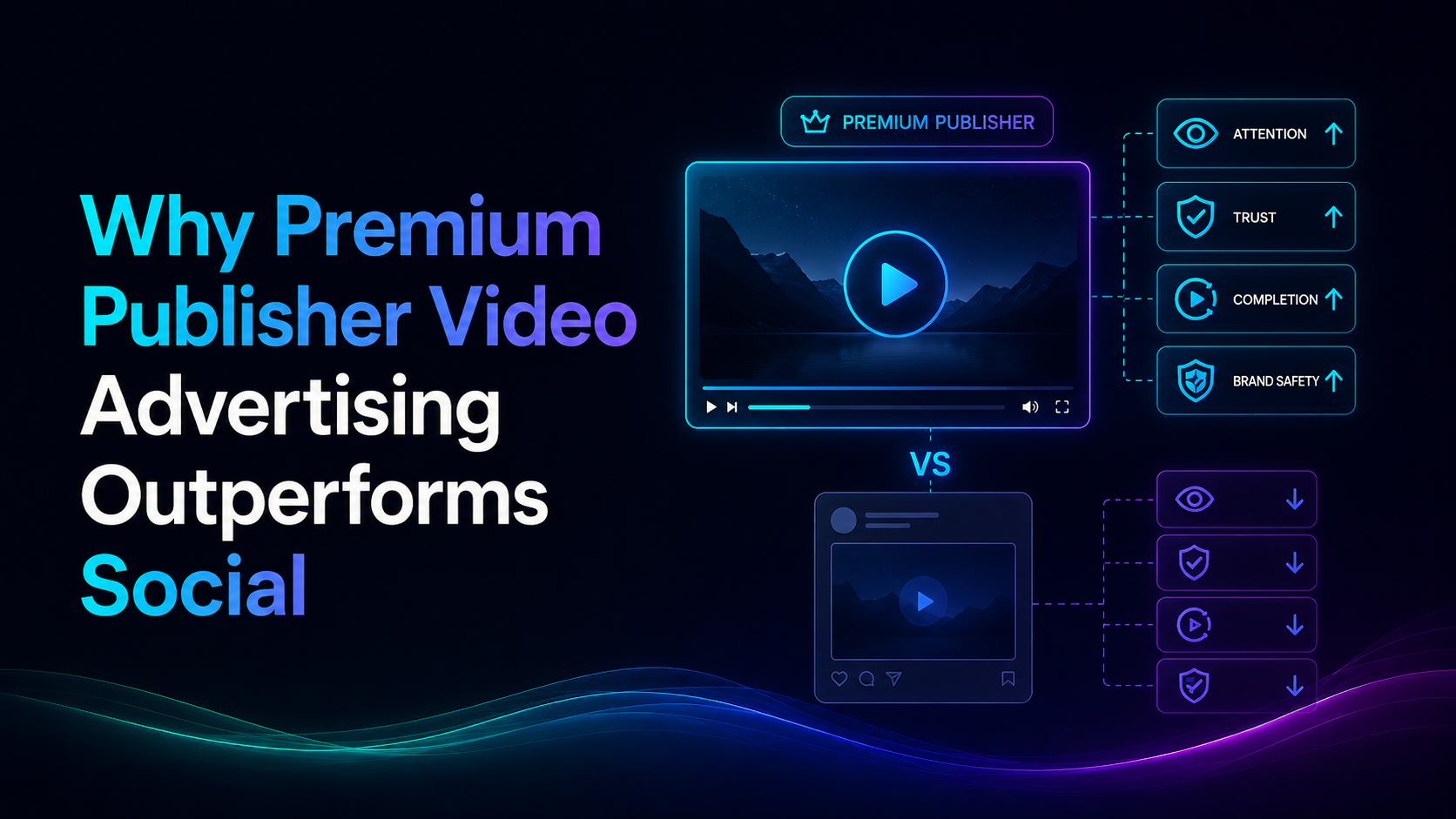
Brands running video advertising in 2026 have a choice. They can continue paying for impressions on social feeds where scroll speed is high, attention is fractured and completion rates are low. Or they can pay for guaranteed completed views on premium publishers - the Wall Street Journal, Forbes, Bloomberg, the Guardian - where Lumen Research data shows video ads attract 140% more attention than social video and brand outcomes are measurably stronger. This post explains the data behind that gap, why it exists, and how brands of any size can now access premium publisher video without enterprise budgets.
The context problem with social video advertising
Social video advertising has a completion problem. Not a reach problem - the platforms are enormous, the targeting is precise, and the inventory is abundant. The problem is what happens when the ad loads.
A user scrolling Instagram or TikTok is in a specific cognitive mode: fast, fragmented, stimulus-responsive. They are moving through a feed that has been algorithmically engineered to maximise scroll velocity. Their thumb is in motion before the ad has a chance to register. The skip button - or the equivalent swipe - is the path of least resistance, and it is exercised constantly.
Lumen Research, the global attention measurement company that uses eye-tracking panels across millions of impressions in 37 countries, has quantified what actually happens to video ads in these environments. Only 30% of technically viewable ads are actually viewed. Approximately 85% of online ads do not pass the 2.5-second attention threshold established by Dr. Karen Nelson-Field at Amplified Intelligence - the minimum duration for an ad to form a memory trace.
The brand recall and consideration advantages of video advertising are entirely contingent on the video being watched. A social feed pre-roll skipped at two seconds is not a video ad that builds brands. It is two seconds of paid noise.
This is the context problem. And premium publisher video exists to solve it.
What makes a publisher premium
Premium publishers - the Wall Street Journal, the New York Times, Forbes, Bloomberg, the Financial Times, the Guardian, Vogue, GQ, Business Insider - share several defining characteristics.
Original editorial investment. Their content is produced by journalists and editors working to specific professional standards. Readers come specifically to consume that content. The relationship between reader and publisher is deliberate and repeat.
Reader intent. Someone reading the Wall Street Journal has chosen to read the Wall Street Journal. They sought out the publication. That intent shapes the cognitive state in which they consume both content and advertising.
Slow scroll environments. Lumen Research data from the Ozone Project study found that scroll speed on premium publisher pages was 55 pixels per second slower on average than on non-premium sites. That slower scroll speed directly increases the probability that an ad comes into view and remains in view long enough to register.
Ad format quality. Premium publishers limit ad density. Unlike made-for-advertising sites that pack multiple ad units onto every page to maximise impression volume, premium publishers maintain editorial integrity by limiting the number of ad placements. Fewer ads per page means each ad carries more relative weight.
What the Lumen Research data actually shows
The most authoritative external data on premium publisher video advertising comes from Lumen Research, which has been measuring advertising attention via eye-tracking panels since 2013.
A study conducted by Lumen for The Ozone Project found that video ads on premium publisher sites attracted 111% more attention than equivalent formats elsewhere on the web. Compared specifically to social channels, the gap was 140% more attention for premium publisher video.
A subsequent Newsworks/Lumen/Peter Field study examining ads on 12 news brand sites versus the top 500 non-news sites found:
- Video ads on news brand sites received 24% more attention than on non-news sites
- Video ads on news brand sites were viewed for 20% longer on average
- Display ads on news brand sites received 40% more attention than on other sites
- High-attention media campaigns achieved 58% more attentive seconds per advertising pound spent
Using data from the IPA Effectiveness Databank, Brand Metrics and Lumen, the research found that advertising in high-attention news brand environments produces 11% higher brand awareness, 23% higher consideration and 32% higher action intent.
Premium publisher video vs social: a direct comparison
The mechanism: why premium editorial environments produce more attention
Dwell time and scroll speed
Readers on premium publisher sites spend more time per page than users on social feeds or low-quality content sites. This reflects the nature of the content. A long-form article in the Financial Times holds a reader for minutes. When a reader is dwelling on a page for longer, the ads on that page have more opportunity to be in the viewing frame for longer durations.
Cognitive engagement transfer
When a reader is actively engaged with quality journalism, that cognitive engagement does not switch off at the exact pixel where editorial content ends and advertising begins. The attentive, processing mindset the reader is in transfers - at least partially - to the adjacent advertising. This is the attention halo effect that Lumen's managing director Mike Follett described: high quality journalism drives deep engagement with the content, which in turn drives high levels of attention to the accompanying ads.
Ad clutter and visual competition
Premium publishers limit their ad inventory. A typical premium publisher page might carry two or three ad placements. A typical open exchange programmatic page might carry twelve or more. Fewer competing ads means each placement claims a larger share of available visual attention.
The credibility transfer
When a brand appears on a premium publisher, the credibility of that publisher transfers - at least partially - to the brand. This is the same mechanism that makes the George Lois/Tommy Hilfiger Times Square story work. In 1985, Hilfiger placed himself alongside Ralph Lauren and Calvin Klein on a billboard. The placement created credibility the brand had not yet earned through product alone. A brand appearing on the Wall Street Journal borrows a portion of that publication's trust relationship with its readers.
Find out how Premium Publisher Video can work alongside LinkedIn.
The Context, Canvas, Creative framework
At VISTY, we describe the premium publisher advantage through three interconnected concepts.
Context is the attention problem. Most video spend optimises for reach. But reach without attention is noise. Social feed video reaches many people. Most of those people do not watch the ad. The context - a high-speed, algorithmically-maximised social feed - works against the advertiser by design.
Canvas is the VISTY solution. The curated allowlist of premium publishers is the canvas on which the brand's video appears. Forbes, WSJ, Bloomberg, the Guardian - these are not just distribution channels. They are the editorial environment that shapes how the ad is received.
Creative is the brand's opportunity. The same creative asset that runs as a skipped pre-roll on YouTube has a materially different impact when completed by a focused reader on the Wall Street Journal. The canvas makes the creative land differently.
The access problem that Attention as a Service solves
If premium publisher video advertising produces categorically better attention outcomes, the obvious question is why more brands are not using it. The answer is structural access.
The Wall Street Journal, Forbes, Bloomberg and the Guardian have historically sold their premium video inventory through direct relationships requiring minimum commitments of £50,000 to £250,000 per quarter, plus agency infrastructure. That is not how most brands operate.
Attention as a Service (AaaS) is the model that removes those barriers. VISTY's subscription platform provides direct access to a curated allowlist of premium publishers - Wall Street Journal, New York Times, Forbes, Bloomberg, the Guardian, Vogue, GQ and others - at a flat CPCV of £0.05 per completed view, from a minimum spend of £1,000 per month. No DSP. No agency. No insertion order. No six-figure minimum.
This is the Moneyball analogy made operational. Premium publisher video used to be a channel reserved for holding company clients. AaaS makes that same inventory quality accessible to the mid-market brand that knows its video should be running on Forbes but has always assumed it could not afford it.
What premium publisher video advertising delivers: concrete numbers
The maths for a brand considering premium publisher video through VISTY:
$5,000 monthly budget: 100,000 guaranteed completed views on premium editorial inventory including WSJ, Forbes, Bloomberg, the Guardian and others. Fixed price. No auction. No variance.
$10,000 monthly budget: 200,000 guaranteed completed views.
For comparison: £5,000 on open programmatic CPM at an average of £8 CPM delivers 625,000 impressions. Of those, Lumen Research data suggests approximately 175,000 will actually be viewed (30% view rate) - and a fraction of those will complete. Premium publisher CPCV delivers 100,000 verified completions for the same spend. The attention quality per dollar is not comparable.
Frequently Asked Questions
Why does video advertising perform better on premium publishers than social media?
Lumen Research data shows that video ads on premium news publisher sites attract 140% more attention than equivalent ads on social channels. The reason is the editorial environment: premium publisher readers are in a focused, deliberate reading mindset with slower scroll speeds and longer dwell times. Social users are in a passive, high-speed scroll mode where skipping is the default behaviour.
What premium publishers can brands advertise on through VISTY?
VISTY's allowlist includes the Wall Street Journal, New York Times, Forbes, Bloomberg, the Guardian, Vogue, GQ, Business Insider and others. Publishers are selected specifically because they deliver the highest attention quality per completed view - editorial environments where readers actively engage with content, producing the slow scroll speeds and longer dwell times that Lumen Research identifies as the primary drivers of advertising attention.
What does premium publisher video advertising cost?
Through VISTY's Attention as a Service model, brands access video advertising on premium publishers at a flat rate of £0.05 per completed view, with a minimum spend of £1,000 per month. Historically, accessing these publishers required direct deals with minimums of £50,000 to £250,000 per quarter, plus agency infrastructure. VISTY removes those barriers entirely.
What brand outcomes does premium publisher video drive?
Research combining data from the IPA Effectiveness Databank, Brand Metrics and Lumen Research found that advertising in high-attention news brand environments drives 11% higher brand awareness, 23% higher consideration and 32% higher action intent. High-attention media campaigns achieve 58% more attentive seconds per advertising pound spent.
Does premium publisher video work for DTC brands, not just B2B?
Yes. VISTY's allowlist includes Vogue and GQ alongside business publications, making premium publisher video effective for consumer brands targeting affluent, engaged audiences. DTC brands spending on Meta and Google often find that adding premium publisher video as a validation layer reduces CAC and improves retargeting performance on performance channels.
Is premium publisher video advertising measurable?
Yes. VISTY reports on completed views, reach, viewability scores, VBAS score and site-level transparency. Every tier of spend receives full reporting. Unlike open programmatic buying where site-level data is often withheld, VISTY provides full visibility into where completed views are being delivered.
Last updated: July 2026
