.png)
What Is Cost Per Completed View (CPCV)? The Metric That Actually Matters
TL;DR
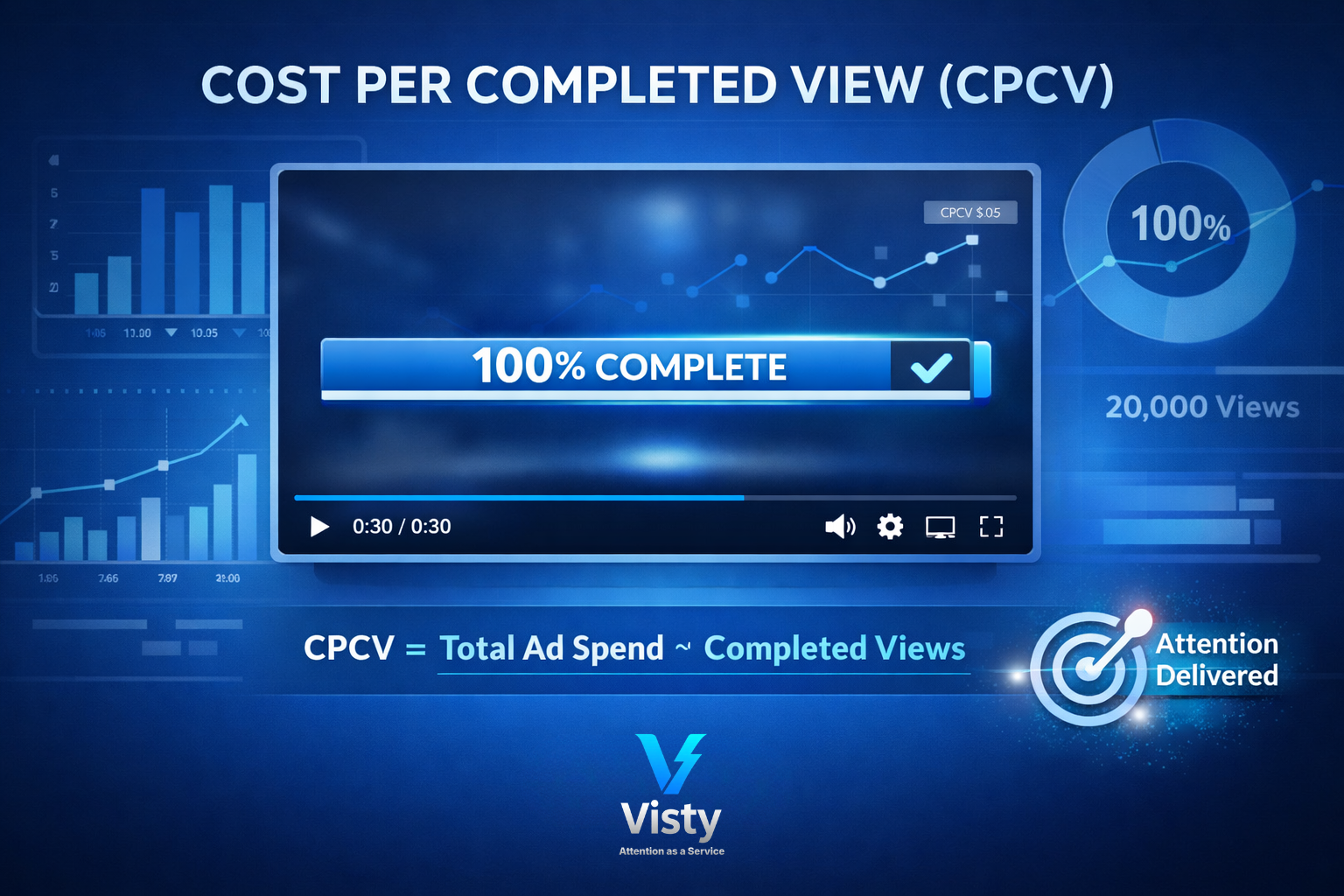
Cost Per Completed View (CPCV) is a video advertising metric that measures what an advertiser pays each time a viewer watches a video ad from start to finish. Unlike CPM (which charges for impressions) or CPV (which charges for partial views), CPCV only counts - and only charges for - ads that were watched to completion. The formula is simple: CPCV = Total Ad Spend ÷ Total Completed Views. Typical benchmarks range from $0.01 to $0.30 per completed view, depending on platform and inventory quality. CPCV is the native metric of Attention as a Service (AaaS).
What CPCV actually measures (and the simple formula)
Cost Per Completed View is exactly what it sounds like: the price you pay per video view that was watched all the way through.
It answers one specific question: How much did it cost me to get someone to watch my entire ad?
The formula could not be simpler:
CPCV = Total Advertising Cost ÷ Number of Completed Views
Example calculation
If you spend £1,000 on a video campaign and receive 20,000 completed views, your CPCV is:
£1,000 ÷ 20,000 = $0.05 per completed view
That means every time someone watched your ad from start to finish, it cost you five cents.
What counts as a "completed view"?
A completed view means the viewer watched the video ad through to the end—no skipping, no scrolling away, no closing the tab halfway through. The viewer saw your full message.
Importantly, different platforms have different technical definitions of "completion," but the principle is the same:
- YouTube TrueView ads: A completed view is 30 seconds, or the full ad if it's shorter than 30 seconds.
- Facebook and Instagram video ads: 15 seconds counts as a full view for standard video ads; 3 seconds for Stories.
- Connected TV (CTV): Completion typically means the ad played in full on the viewer's screen, with no skipping.
- Mobile in-app video: Completion is usually defined as 100% of the ad's duration.
For most video advertising - especially brand-focused campaigns - the industry standard is clear: a completed view means the ad was watched to the end.
CPCV vs CPV vs CPM: A plain-English comparison
CPCV is often confused with two other video advertising metrics: CPV (Cost Per View) and CPM (Cost Per Mille). They sound similar, but they measure fundamentally different things - and charge advertisers in fundamentally different ways.
The key difference: what "view" actually means
- CPM measures opportunity. Your ad appeared. That is all.
- CPV measures interest. Someone started watching. They may not have finished.
- CPCV measures attention. Someone watched your entire message.
This is why CPCV has become the standard for brands that care about message delivery, not just eyeball counts.
Why completed views are a stronger signal than impressions or clicks
In digital advertising, not all metrics are created equal. Some signal intent. Some signal interest. And some - like impressions - signal almost nothing at all.
Here is the hierarchy of engagement signals, from weakest to strongest:
- Impressions (CPM): The ad loaded on a screen. The user may have scrolled past it without looking.
- Clicks (CPC): The user clicked on the ad. This signals curiosity, but not necessarily sustained interest. Clicks can be accidental, reflexive, or driven by misleading creative.
- Partial views (CPV): The user started watching the video. This is a stronger signal than a click, but many viewers drop off after a few seconds.
- Completed views (CPCV): The user watched the entire ad. This is the strongest standard signal available in video advertising. A completed view indicates voluntary attention, message absorption, and engagement.
Why completion matters for brand recall
Research on attention and memory shows that there is a minimum threshold for an ad to register in a viewer's mind. Dr. Karen Nelson-Field's work at Amplified Intelligence found that ads need at least 2.5 seconds of active attention to form a memory. Anything below that threshold might drive a reflexive click, but it cannot build brand recall.
A completed view - by definition - clears that threshold. If someone watches a 15-second ad to the end, they have given you 15 seconds of attention. That is enough time to deliver a message, establish a brand association, and create mental availability. However, context also matters here - not all inventory is equal. e.g. an in-banner display ad placed in the bottom right hand corner of a page, with partial viewability may count as a completed view in traditional programmatic buys. With attention as a Service, placements are focused in on inventory that has proven to be highly attentive, and seen by a human eye.
A partial view might give you 3 seconds. An impression might give you zero.
This is why advertisers who care about long-term brand building are moving away from CPM and toward CPCV. You are not paying for ads that disappear. You are paying for ads that land.
Where CPCV fits in the marketing funnel (upper + mid)
CPCV is not a conversion metric. It does not measure purchases, sign-ups, or downloads. What it does measure is attention and message delivery - which makes it ideal for the upper and mid-funnel stages of the marketing funnel.
Upper funnel: awareness and brand building
At the top of the funnel, your goal is to make people aware that your brand exists and to establish what you stand for. Completed views are perfect for this.
A viewer who watches a 30-second brand video to the end has absorbed your positioning. They know who you are. They have seen your product. They have heard your message. That is the foundation of brand recall.
Lumen Research and Ebiquity's joint study found a 0.98 correlation between attentive minutes and incremental profit across six media types. In other words, attention almost perfectly predicts revenue. And a completed view, optimized to the right publishers and formats, is a guaranteed unit of attention.
Find out how optimizing for attention on premium publishers works alongside LinkedIn video.
Mid-funnel: consideration and retargeting
Once someone is aware of your brand, the next stage is consideration. Mid-funnel campaigns aim to move prospects from "I've heard of you" to "I'm thinking about buying from you."
CPCV is valuable here because completed views create high-quality retargeting pools. A viewer who watched your full ad is far more likely to engage with a follow-up performance asset (like a product demo or a limited-time offer) than someone who only saw an impression.
Platforms like VISTY, Meta and Google allow advertisers to build custom audiences based on video completion. You can retarget people who watched 95% or 100% of your ad, creating a segment of highly engaged prospects who have already demonstrated interest.
Lower funnel: CPCV alone is not enough
CPCV is not a bottom-funnel metric. It does not measure conversions, and it should not be used as the primary KPI for direct-response campaigns where the goal is immediate sales or sign-ups.
For lower-funnel activity, metrics like CPA (Cost Per Acquisition) or ROAS (Return on Ad Spend) are more appropriate. However, CPCV complements these metrics. A strong upper-funnel CPCV campaign creates the awareness and consideration that makes lower-funnel campaigns more efficient.
Think of it this way: CPCV builds the audience. CPA converts it.
How CPCV connects to attention: a completed view IS an attention event
The reason CPCV has become central to the attention economy is simple: a completed view is a verified attention event.
Unlike an impression - which only tells you that an ad loaded - a completed view tells you that someone chose to watch your message all the way through. That choice is what makes it valuable.
The IAB/MRC attention standards and CPCV
In November 2025, the IAB (Interactive Advertising Bureau) and MRC (Media Rating Council) released formal Attention Measurement Guidelines, establishing the first industry-wide framework for how attention should be defined and tracked across digital advertising.
The standards introduce three levels of attention measurement:
- Exposure-based: Did the ad appear on screen in a viewable position?
- Engagement-based: Did the viewer interact with the ad (click, expand, complete)?
- Outcome-based: Did the ad drive a measurable business outcome?
CPCV fits squarely in the engagement-based tier. Completion is a behavioral signal. It is not a passive exposure metric like viewability, and it is not a proxy metric like time-in-view. It is a direct measure of whether someone consumed your entire message.
CPCV vs attention measurement firms (Lumen, Adelaide)
Companies like Lumen Research and Adelaide have built sophisticated models to predict attention. Lumen uses eye-tracking data to estimate which placements are likely to capture a viewer's gaze. Adelaide assigns an AU (Attention Unit) score to placements based on their predicted attention and business impact.
These tools are valuable for media planning - they help you choose placements that are likely to perform well. But they are still predictive. They tell you what should happen, not what did happen.
CPCV, by contrast, is a verified outcome. You are not paying for the prediction that someone might watch your ad. You are paying for the confirmed fact that they did. When coupled with verification from Adelaide for example, this becomes a powerful proxy for predicting campaign impact on brand growth.
This is the core principle of Attention as a Service (AaaS): instead of only measuring attention and then hoping to buy it, you buy attention directly - in the form of completed views, at a fixed price, on formats that have proven to capture audience attention.
What a good CPCV benchmark looks like in 2026
CPCV benchmarks vary widely depending on platform, ad format, placement quality, and targeting. But here are the ranges you should expect based on 2024 and 2025 industry data:
Mobile in-app inventory
£0.01 to £0.07 per completed view
Mobile in-app placements - especially rewarded video formats - deliver some of the lowest CPCVs in the market. Rewarded video is a format where users receive an in-app reward (like extra lives in a game) in exchange for watching a video ad to completion. Because the user opts in, completion rates are very high (often 90%+), and CPCVs are correspondingly low.
Open exchange / programmatic video
£0.01 to £0.10 per completed view
Programmatic video inventory across open ad exchanges typically falls in this range. Quality varies significantly - some placements are premium publisher inventory (e.g., news sites, lifestyle publishers), while others are lower-quality made-for-advertising (MFA) sites. While CPCV's can sometimes look attractive, the lack of transparency o site delivery can typically mean your budget is being spent on cheap impressions, on low quality sites.
YouTube TrueView
£0.03 to £0.30 per completed view
YouTube's TrueView format allows viewers to skip ads after 5 seconds, which means advertisers only pay when someone chooses to watch. This self-selection mechanism drives higher CPCVs than non-skippable formats, but it also delivers higher-quality engagement. Viewers who choose to watch are more likely to be genuinely interested.
Connected TV (CTV)
£0.10 to £0.50+ per completed view
CTV placements command the highest CPCVs because they deliver the highest completion rates - often 95% or higher, according to Innovid's 2024 Global Benchmarks Report. CTV viewers are in a "lean-back" environment, watching content on a large screen with few distractions. They are far more likely to watch an ad to completion than someone scrolling on mobile.
Premium CTV inventory (e.g., Hulu, Peacock, Paramount+) can push CPCVs above £0.50, but the attention quality justifies the cost. There are still plenty of challenges within CTV, in particular with inventory quality so it's always best to question your provider of choice for more information on where your ads are being shown.
Premium publisher direct deals
£0.05 to £0.20 per completed view
Premium publishers like The New York Times, Forbes, and Vogue deliver high-quality placements with strong brand safety and high completion rates. These placements typically sit in the mid-range for CPCV - more expensive than open exchange inventory, but more affordable than CTV.
This is the inventory tier that VISTY specializes in: premium, brand-safe placements at fixed CPCVs, delivered via a subscription model rather than an auction.
What is a "good" CPCV?
A good CPCV depends on your goals:
- For broad awareness campaigns, anything under £0.10 is efficient.
- For mid-funnel consideration, £0.10 to £0.20 is acceptable if the placement quality is high.
- For premium brand-building, £0.20 to £0.50 can be justified if the environment (CTV, premium publishers) delivers sustained attention.
The key is to compare CPCV to the alternative. If you were buying the same inventory on a CPM basis, you would be paying for impressions that may never turn into views. With CPCV, you are paying only for verified attention.
Want to find out what the best video advertising platforms for B2B SaaS in 2026 are?
How to lower your CPCV (without sacrificing quality)
If you are running CPCV campaigns and want to improve efficiency, here are the levers you can pull:
1. Shorten your creative
Completion rates drop as ad length increases. According to 2025 benchmarks, videos under 15 seconds achieve completion rates 53% higher than videos over 30 seconds. Videos under 60 seconds see a 66% completion rate, while videos between 1–2 minutes drop to 56%.
If your message can be delivered in 15 seconds instead of 30, your completion rate will rise - and your CPCV will fall.
2. Hook viewers in the first 3 seconds
Most viewers decide whether to keep watching within the first few seconds. Creative that leads with a strong visual hook, a surprising statement, or immediate value tends to hold attention longer.
TikTok's December 2024 algorithm update shifted the engagement threshold from 3–5 seconds to 15–20 seconds, meaning your content now needs to sustain interest for longer to receive sustained algorithmic distribution. The same principle applies to paid video ads: if you lose the viewer in the first 5 seconds, you lose the completed view.
3. Target the right audience
Broad targeting may deliver cheaper impressions, but it often results in lower completion rates. If your ad reaches people who have no interest in your product, they will skip it.
Refining your targeting to reach a more relevant audience may increase your CPM slightly, but it will improve your completion rate - and lower your CPCV overall.
4. Use high-attention placements
Not all inventory is created equal. CTV delivers 95% completion rates. Mobile display video delivers closer to 64% on average (Unity data). If you want to maximize completions, prioritize placements where viewers are more engaged.
This is the logic behind Attention as a Service: instead of bidding on low-quality inventory and hoping for completions, you buy completed views directly from high-attention placements.
CPCV is the native metric of Attention as a Service
If you have read this far, you understand why CPCV matters: it is the only standard video metric that guarantees attention was delivered, not just attempted.
This is why CPCV is the foundation of Attention as a Service (AaaS). AaaS platforms like VISTY sell completed views at a fixed price, removing the auction volatility and waste that plague CPM buying.
Instead of bidding on impressions and then tracking how many turned into completed views, you buy the completed views directly. The price is locked. The inventory is premium. The outcome is guaranteed.
No auction. No volatility. No gambling on whether your message was seen.
Frequently Asked Questions
What does CPCV stand for?
CPCV stands for Cost Per Completed View. It is a video advertising metric that measures the cost an advertiser pays each time a viewer watches a video ad from start to finish.
How is CPCV different from CPV?
CPV (Cost Per View) charges you when a viewer watches a minimum portion of your video - typically 30 seconds on YouTube, or 2 seconds on platforms like Facebook. CPCV only charges you when the viewer watches the entire video to completion. CPV is cheaper per view, but CPCV delivers stronger engagement.
How is CPCV different from CPM?
CPM (Cost Per Mille) charges you per 1,000 impressions - ads served, whether anyone watched them or not. CPCV only charges you for completed views. CPM is an exposure metric. CPCV is an attention metric. They measure fundamentally different things.
What is a good CPCV for video advertising in 2026?
A good CPCV depends on platform and placement quality. Mobile in-app inventory typically runs $0.01–$0.07 per completed view. Programmatic open exchange ranges from $0.01–$0.10. YouTube TrueView runs $0.03–$0.30. Connected TV (CTV) can range from $0.10–$0.50+. Premium publisher placements typically fall in the $0.05–$0.20 range. Compare your CPCV to these benchmarks based on where you are buying.
How do I calculate CPCV for my campaign?
Use this formula: CPCV = Total Ad Spend ÷ Number of Completed Views. For example, if you spent $500 and received 10,000 completed views, your CPCV is $500 ÷ 10,000 = $0.05 per completed view.
Does CPCV work for campaigns that are not video?
No. CPCV is specifically a video advertising metric. It measures completed views of video ads. For non-video campaigns, other metrics apply: CPC (cost per click), CPM (cost per thousand impressions), CPA (cost per acquisition), or CPE (cost per engagement).
Why is my CPCV higher on some platforms than others?
CPCV varies based on completion rates and competition. Platforms with high completion rates (like CTV at 95%) tend to have higher CPCVs because the inventory is more valuable. Platforms with lower completion rates (like mobile display at ~64%) have lower CPCVs because more ad plays do not result in completed views. Additionally, auction-based platforms fluctuate based on demand - CPCVs can spike during high-competition periods like Q4.
Can I buy media directly on a CPCV basis, or do I have to calculate it afterward?
Some platforms (like YouTube TrueView, Unity, and rewarded video networks) allow you to buy on a CPCV basis - you are billed only when a view completes. Other platforms (like Meta or programmatic DSPs) bill on CPM or CPV, and you calculate CPCV afterward as a performance metric. Attention as a Service (AaaS) platforms like VISTY sell completed views at a fixed CPCV directly, without requiring auction-based buying.
Is a lower CPCV always better?
Not necessarily. A low CPCV is efficient, but efficiency is not the only goal. If your CPCV is low because your ad is running on low-quality inventory with poor brand safety, you may be wasting money even at a cheap price. The best CPCV is one that balances cost efficiency with placement quality, brand safety, and audience relevance.
Last updated: March 2026
