.png)
What Is the Attention Economy? A Plain-English Definition
The one-sentence definition
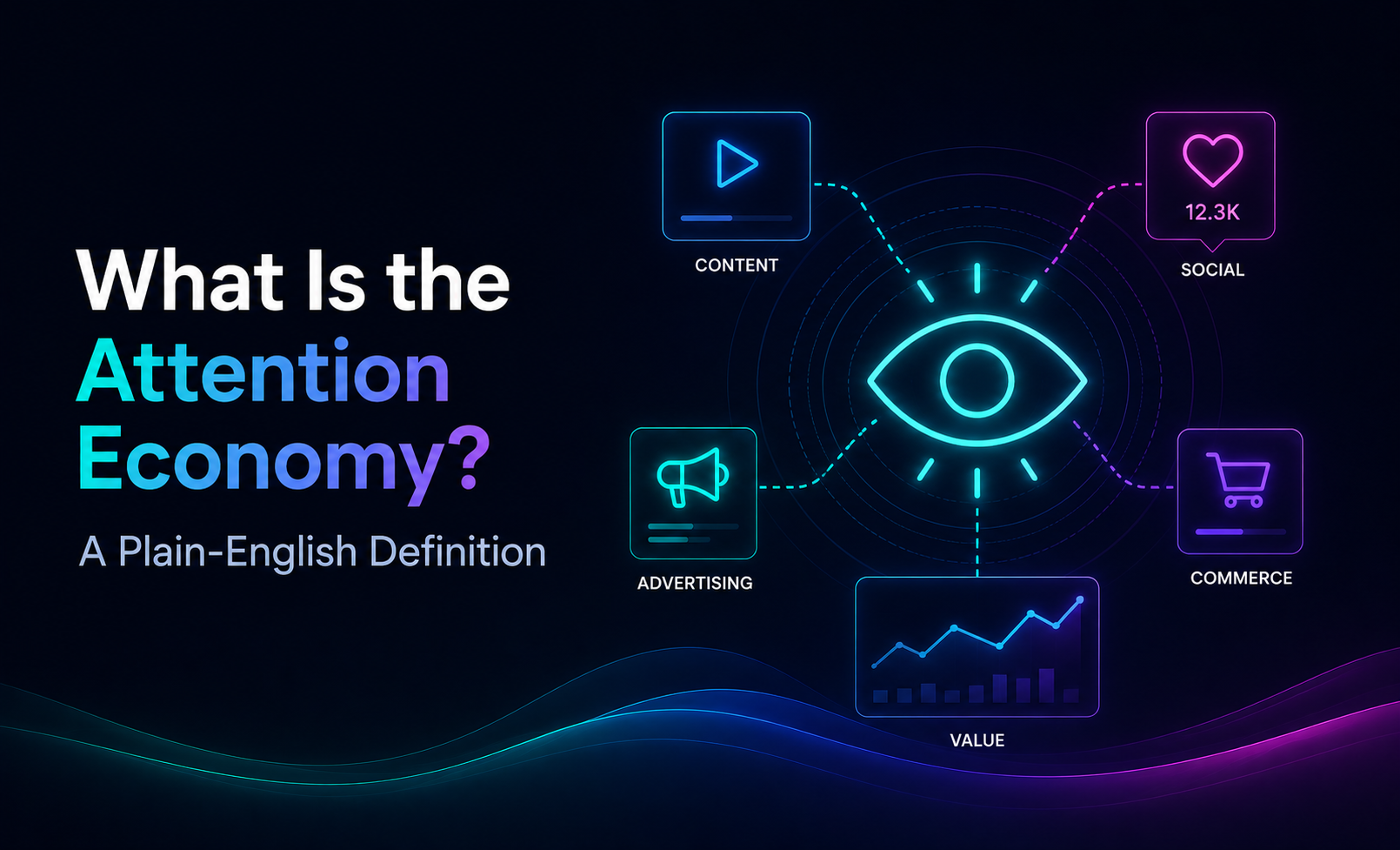
The attention economy is an economic framework that treats human attention as a scarce, finite resource -the limiting factor in an information-rich environment where supply exceeds the capacity to consume it.
Where the idea came from: Herbert Simon's "wealth of information, poverty of attention"
The concept of the attention economy was first articulated by economist and psychologist Herbert A. Simon in a 1971 paper titled "Designing Organizations for an Information-Rich World."
Simon observed that as information becomes more abundant, attention becomes more scarce. He wrote:
"In an information-rich world, the wealth of information means a dearth of something else: a scarcity of whatever it is that information consumes. What information consumes is rather obvious: it consumes the attention of its recipients."
Simon framed attention not as a psychological phenomenon, but as an economic resource - subject to the same principles of scarcity, allocation, and trade-offs that govern markets for physical goods.
In 1971, this was theoretical. By the 2020s, it became operational reality.
What it means in practice for brands and advertisers
In practice, the attention economy means that brands are not competing for space - they are competing for focus.
The average person is exposed to between 6,000 and 10,000 ads per day across digital, social, connected TV, and out-of-home channels. But the human brain has hard limits on how many things it can process at once.
Research by Dr. Karen Nelson-Field at Amplified Intelligence shows that around 85% of digital ads fail to reach the 2.5-second attention threshold required for memory formation. That means the vast majority of advertising does not reach the minimum threshold required to register in someone's mind.
Attention is the bottleneck. Not inventory. Not reach. Not impressions.
This creates a fundamental shift in how value is measured:
- In the impression economy, the scarce resource was ad space. Publishers sold inventory. Advertisers bought placements.
- In the attention economy, the scarce resource is viewer focus. Publishers sell moments of attention. Advertisers buy outcomes—verified instances when someone actually looked, watched, and absorbed the message.
Why attention became a tradeable asset
For most of digital advertising's history, attention was not measured. It was assumed.
The industry operated on proxies:
- Impressions assumed that if an ad loaded, someone might have seen it.
- Viewability assumed that if 50% of an ad's pixels appeared on screen for 1+ seconds, someone probably glanced at it.
- Clicks assumed that if someone clicked, they must have been paying attention.
None of these assumptions held up under scrutiny.
Eye-tracking studies by Lumen Research found that only 30% of viewable ads are actually viewed. The other 70% load on screen and vanish - scrolled past, ignored, or displayed in a browser tab no one is looking at.
As measurement technology improved - eye-tracking, engagement signals, neurometric analysis - attention became quantifiable. And once it could be measured, it could be traded.
In November 2025, the Interactive Advertising Bureau (IAB) and Media Rating Council (MRC) formalized this shift by releasing comprehensive Attention Measurement Guidelines - the first industry-wide standards for how attention should be defined, tracked, and reported.
Attention is no longer a research project. It is a currency.
How the attention economy connects to how ads are bought and sold today
The attention economy has fundamentally changed the transaction in digital advertising.
The old model: paying for exposure
In the impression-based economy, advertisers paid for exposure - the opportunity for an ad to be seen. The metric was CPM (cost per mille, or cost per thousand impressions).
This model optimized for volume: serve as many ads as possible, to as many people as possible, and hope some of them pay attention.
The new model: paying for attention
In the attention economy, advertisers pay for attention - verified moments when someone actually focused on the ad.
This shift manifests in three ways:
1. Outcome-based metrics replace exposure metrics
Instead of paying for impressions (ads served), advertisers now pay for:
- CPCV (Cost Per Completed View): A video ad watched from start to finish
- Attentive CPM (aCPM): Impressions weighted by their predicted attention value (Lumen Research)
- Attention Units (AU): A 0–100 score predicting a placement's probability of attention and business impact (Adelaide)
2. Measurement tools quantify attention, not just delivery
Companies like Lumen Research, Adelaide, Amplified Intelligence, DoubleVerify, and IAS now measure whether an ad actually captured viewer focus - using eye-tracking, engagement signals, and neurometric data.
These tools allow advertisers to compare attention across placements, platforms, and formats - and to optimize campaigns for attention, not just reach.
3. Attention as a Service (AaaS) platforms guarantee delivery
The final evolution is platforms that sell attention as a subscription-based utility. Instead of bidding on impressions and hoping they turn into attention, brands buy completed views at a fixed price.
This is the model behind Attention as a Service (AaaS) - platforms like VISTY that treat attention the way SaaS treats software: predictable, outcome-guaranteed, and subscription-based.
The bottom line
The attention economy is not a trend. It is a structural shift in how value is created and captured in advertising.
In an information-rich world where people are exposed to thousands of messages per day, the scarce resource is no longer ad space- it is human focus. Brands that optimize for attention, not just impressions, are the ones that build memory, influence consideration, and drive business outcomes.
The question for advertisers in 2026 is simple: Are you still buying exposure, or are you buying attention?
Learn how the attention economy is reshaping advertising in 2026 →
Frequently Asked Questions
Who coined the term "attention economy"?
The term "attention economy" was coined by economist and psychologist Herbert A. Simon in 1971 in his paper "Designing Organizations for an Information-Rich World." Simon argued that in an information-rich environment, the scarce resource is not information - it is the attention required to process it.
What does the attention economy mean for digital advertising?
In digital advertising, the attention economy means that brands are competing for viewer focus, not just ad placements. Instead of paying for impressions (ads served), advertisers now optimize for attention metrics like CPCV (Cost Per Completed View) and AU (Attention Units) that measure whether someone actually watched the ad. The shift is from buying exposure to buying verified attention.
How is attention measured in advertising?
Attention is measured using three primary methods: (1) eye-tracking (cameras track where a viewer's gaze lands and for how long), (2) engagement signals (behavioral data like time-in-view, scroll depth, and video completion predict attention), and (3) neurometric analysis (brain activity measures cognitive engagement). The IAB and MRC released formal Attention Measurement Guidelines in November 2025 to standardize these methods.
What is the difference between the attention economy and the impression economy?
In the impression economy, advertisers pay for ad space - the opportunity for an ad to be served. The metric is CPM (cost per thousand impressions). In the attention economy, advertisers pay for viewer focus - verified moments when someone actually looked at the ad. The metric is attention-based: CPCV (cost per completed view), aCPM (attentive CPM), or AU (attention units). The former optimizes for reach; the latter optimizes for engagement.
Is the attention economy just another buzzword?
No. The attention economy is backed by formal industry standards (IAB/MRC Attention Measurement Guidelines, November 2025), adopted by major brands (Duolingo, Adobe, Marriott declared it "the new currency" at Advertising Week 2025), and supported by research showing that attention predicts business outcomes (Lumen/Ebiquity found a 0.98 correlation between attention and incremental profit). It is a structural shift, not a trend.
Last updated: May 2026
