.png)
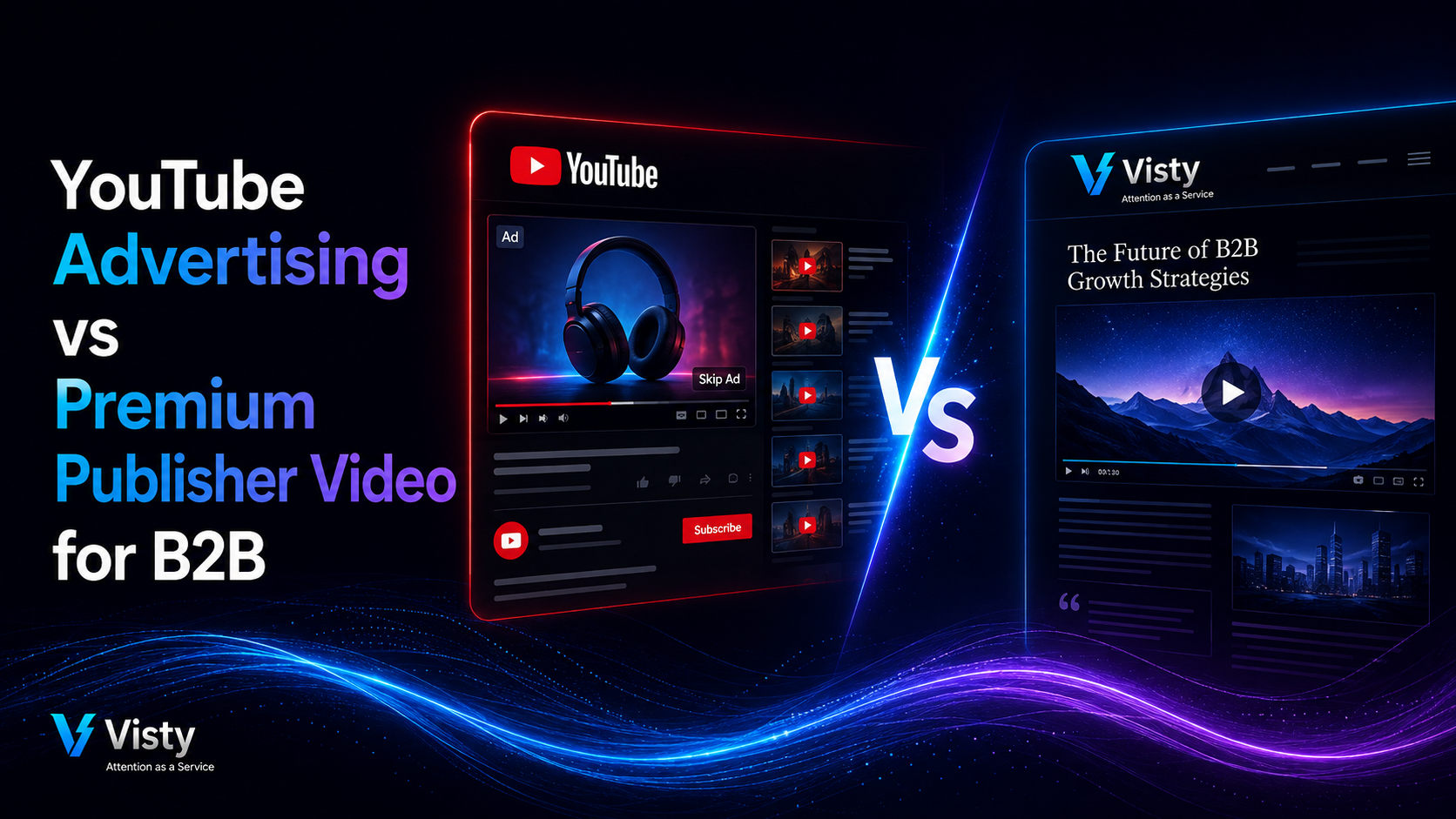
YouTube Advertising vs Premium Publisher Video for B2B
TL;DR: YouTube and premium publisher video are not an either/or. YouTube is genuinely strong for one thing: cheap reach at scale. But its reach comes from an open, user-generated platform where the viewer can skip after five seconds and your ad can land next to almost anything. Premium publisher video does the opposite: a guaranteed completed view, in a brand-safe editorial environment, in front of senior decision-makers. This page compares the two honestly, and shows how they work best layered.
The honest answer first
We are not here to replace YouTube. Nobody replaces YouTube. It is the second-largest search engine on earth and the cheapest way to put a video in front of a very large number of people. If your objective is broad reach at low cost, YouTube earns its budget, and premium publisher video is not trying to take that job from it.
But reach and attention are not the same purchase, and YouTube's model makes that gap concrete. The viewer can skip after five seconds. The environment is open user-generated content, which is where the cheap reach comes from and also where the brand-safety risk lives. Premium publisher video is built for the other half of the equation: a guaranteed completed view, in editorial you can name, in front of the senior decision-makers you are actually trying to reach. Run together, YouTube casts the wide net and premium publisher video guarantees the catch.
What YouTube does well
Credit where it is due, and this matters, because the completion and brand-safety arguments below only land if the strengths are stated honestly first.
- Reach at scale. Almost no channel matches YouTube for putting a video in front of a large audience quickly.
- Low cost per view. YouTube is genuinely cheap on a cost-per-view basis, and its skip model means you are not charged when someone skips. Every skip is a free brand impression.
- A real view threshold. Unlike a two-second auto-play, YouTube counts a view at 30 seconds watched, or a click. When someone does watch, that is a meaningful, engaged view.
If your goal is efficient top-of-funnel reach, YouTube is a strong channel. Keep it.
Where YouTube leaves a gap: completion
The strength and the weakness are the same feature. YouTube's cheap reach comes from letting viewers skip, and most of them do. Industry benchmarks put the skip rate at around 65% after the five-second mark, and the average view rate, meaning the share who watch 30 seconds or more, at roughly 32%. So on a typical campaign, close to two-thirds of the people your ad reaches never see past the opening five seconds.
That is fine if reach is all you want, because the skips are free. But it means YouTube optimises for the self-selecting minority who chose to keep watching, and you have no control over whether any given member of your target audience is in that minority or the majority who bailed. Premium publisher video removes that variable. With VISTY you buy on cost per completed view: the view has to finish before you are charged. You are not buying the chance of attention. You are buying attention that happened.
Where YouTube leaves a gap: brand safety
This is the one that should worry a B2B brand most, and it is structural, not occasional. YouTube's reach comes from running against the open long tail of user-generated content, and that has produced a recurring pattern of brand-safety failures. In 2017, major advertisers including AT&T, Verizon, PepsiCo and Walmart paused their YouTube campaigns after their ads were found running alongside extremist and hate content. Similar incidents have kept surfacing in the years since. It is a whack-a-mole problem: advertisers find out after the fact that their ad appeared somewhere it should not have, then blocklist it.
It matters commercially because consumers hold the brand responsible, not the platform. Research has found around 80% of consumers will reduce or stop buying a product they have seen advertised next to extreme or violent content. And 2026 has added a new adjacency risk: a majority of media professionals now cite ad proximity to low-quality, AI-generated content as a top brand-safety concern for the year. YouTube gives you tools to manage this, exclusion lists, suitability settings, placement controls, but managing it is a permanent, active job, and the failures still happen.
Premium publisher video answers this by construction rather than by exclusion. A named premium publisher network, shared with you in advance, is brand-safe because of where it runs, not because of what has been filtered out. There is no long tail to police. You know exactly which titles your brand appears on before launch.
What premium publisher video does differently
Premium publisher video reaches a different audience in a different state, and it changes what you are buying.
A guaranteed completed view. No skip, no partial view, no "chance of attention". You pay when a view finishes, on a flat £0.05 per completed view, from a £1,000 per month minimum. This is the core of Attention as a Service: you buy attention that actually happened. For the model in full, see what cost per completed view (CPCV) actually means.
A senior audience in a considered mindset. YouTube reaches everyone in a lean-back, entertainment frame. Premium editorial reaches senior decision-makers while they are reading, deliberately. The publishers report the skew themselves: the Wall Street Journal puts around 70% of its audience in the C-suite, and VentureBeat reports 39% at C-level and over 6 million business decision-makers a month. That is who a B2B brand is trying to reach, in the state where they are actually paying attention.
Measurably more attention. The environment does work the feed and the open exchange cannot. Lumen Research data shows video ads on premium news sites attract 140% more attention than social video, and the same premium-environment advantage applies against the open, distracted context of much YouTube inventory. The full attention argument, with the memory-trace research behind it, is set out in premium publisher video vs social.
The cost reality, stated honestly
YouTube is cheaper per view than premium publisher video, and it is worth saying so plainly rather than pretending otherwise. But the two prices buy different things. YouTube's low cost per view buys a skippable view on open inventory, where most people skip and your brand may land anywhere. VISTY's completed view costs more because it buys a guaranteed completion, in a brand-safe environment, in front of a senior audience. It is not a more expensive version of the same unit. It is a different unit. The right question is not "which is cheaper per view", but "which view is worth paying for".
How to run them together
You do not choose. You layer, and the three C's make the split clear: Context, Canvas and Creative.
- YouTube for cheap, broad reach at the top of the funnel, casting the widest possible net.
- Premium publisher video for guaranteed completed attention from senior decision-makers, in a brand-safe context, converting reach into remembered exposure.
The same creative that runs as a skipped pre-roll on YouTube lands differently when it is completed by a focused reader on the Wall Street Journal. YouTube gets your video seen by many. Premium publisher video makes sure it is watched by the ones who matter. For the wider channel picture, see the best video advertising platforms for B2B SaaS, and if LinkedIn is in your mix, how premium publisher video compares to LinkedIn.
Frequently asked questions
Is YouTube not cheaper than premium publisher video?
Per view, yes, and that is worth being honest about. But the two prices buy different things. YouTube's low cost per view buys a skippable view on open user-generated inventory, where most viewers skip after five seconds and your ad can appear next to almost anything. VISTY's completed view costs more because it buys a guaranteed completion in a brand-safe premium environment, in front of senior decision-makers. Different unit, different purchase.
Can I control where my ad runs on YouTube?
Only up to a point, and only through constant management. YouTube gives you exclusion lists, suitability settings and placement controls, but the platform is open user-generated content, adjacency incidents still happen, and policing them is a permanent job. Premium publisher video is different: VISTY runs on a named premium publisher network, shared with you in advance, so brand safety comes from where the ad runs rather than from what you managed to filter out.
Should I replace YouTube with premium publisher video?
No. They do different jobs. YouTube is strong for cheap, broad reach at the top of the funnel. Premium publisher video guarantees completed views from senior decision-makers in a brand-safe environment. Run together, YouTube casts the net and premium publisher video guarantees the catch.
How do I prove premium publisher video worked if it does not drive a direct click?
The same way you prove any brand-level channel, with proxy metrics rather than last-click. Track branded search lift, on-site conversion-rate lift among target accounts, and unique UTM-tagged landing pages for the campaign. VISTY also reports audience-delivery indices validated against Dun and Bradstreet data, so you can show which seniorities the campaign actually reached.
Does premium publisher video work for DTC brands, not just B2B?
Yes. The premium publisher network includes consumer titles alongside business ones, so it works for DTC brands targeting affluent, engaged audiences as well as B2B brands reaching senior decision-makers. DTC brands running heavily on YouTube and Meta often add premium publisher video as a validation layer to build trust that performance channels alone do not.
Book a 20-minute call to see what guaranteed completed views on premium publishers look like for your brand.
This is Attention as a Service. This is VISTY.
Visibility. Done Simple.
