.png)
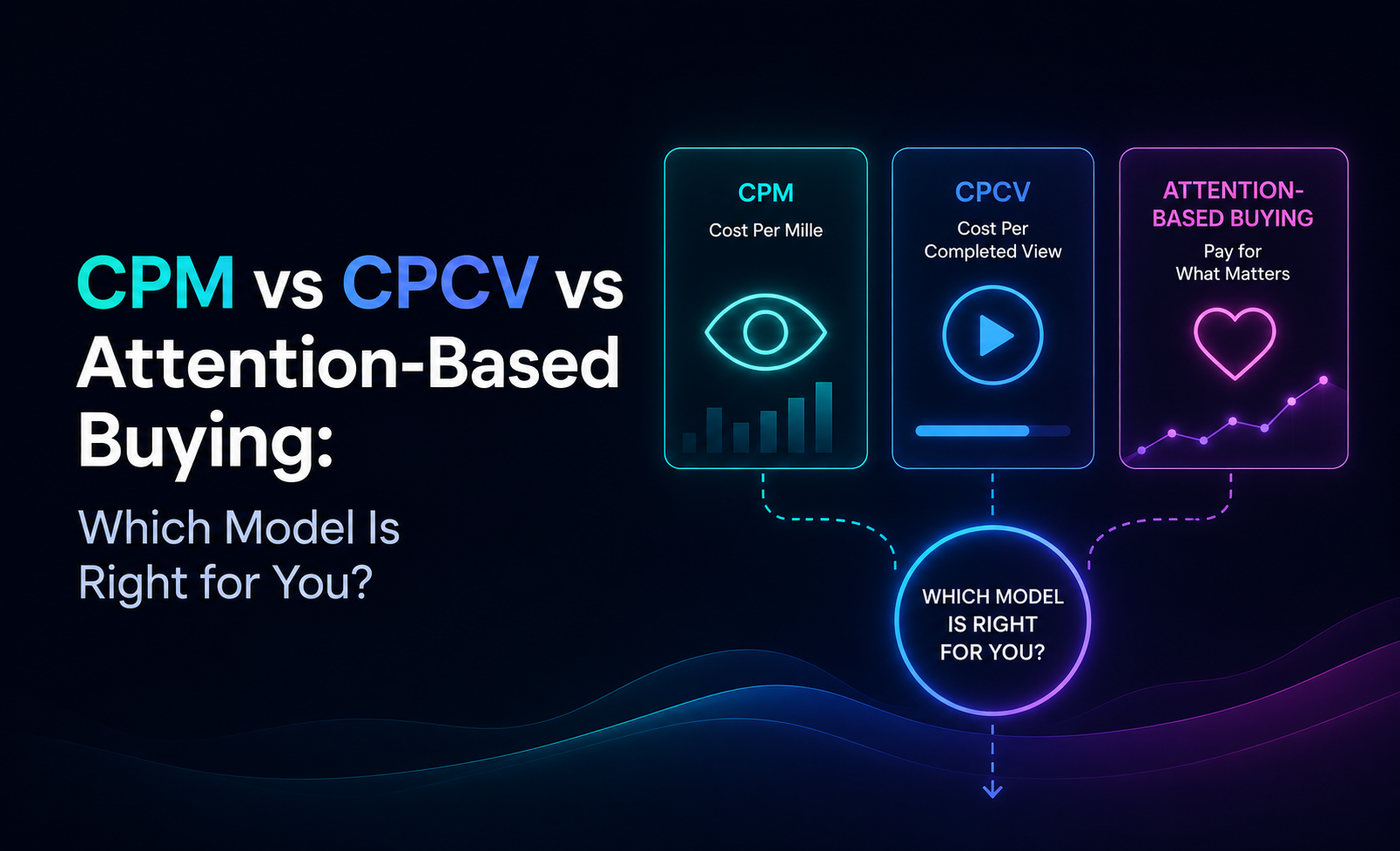
CPM vs CPCV vs Attention-Based Buying: Which Model Is Right for You?
TL;DR
There are three main ways to buy video advertising in 2026: CPM (Cost Per Mille, paying per 1,000 impressions), CPCV (Cost Per Completed View, paying per full video view), and Attention-Based Buying (fixed-price, guaranteed completed views via platforms like AaaS). CPM is the cheapest per unit but carries high waste risk - 70% of viewable ads are never actually seen. CPCV charges only for completed views, eliminating unseen ad waste, but pricing still fluctuates based on auction dynamics. Attention-Based Buying (AaaS) locks in a fixed price per completed view and guarantees delivery, removing both waste and volatility. The right model depends on your budget size, risk tolerance, and whether you prioritize cost efficiency or outcome certainty.
The three main ways to buy video ads today
Digital video advertising is bought and sold using three distinct pricing models. Each model charges for something different, carries different risks, and suits different advertiser needs.
Understanding the differences is not academic - it directly impacts how much of your budget reaches actual viewers versus how much is absorbed by waste, volatility, and invisible ads.
Here are the three models:
1. CPM (Cost Per Mille) - Paying for impressions
CPM stands for "cost per mille" (Latin for thousand). You pay a fixed rate for every 1,000 times your video ad is served - meaning it loads on a page or in an app, regardless of whether anyone watches it.
What you're buying: The opportunity for your ad to be seen.
What you're NOT buying: Any guarantee that it will actually be viewed.
CPM has been the dominant model in digital advertising for two decades. It is how programmatic exchanges work, how most DSPs (demand-side platforms) price inventory, and how publishers sell remnant video placements.
2. CPCV (Cost Per Completed View) - Paying for full engagement
CPCV stands for "cost per completed view." You pay only when a viewer watches your video ad from start to finish - no skipping, no scrolling away, no partial views.
What you're buying: Verified, completed engagement with your message.
What you're NOT buying: Impressions that may never be seen or partial views that drop off mid-ad.
CPCV is commonly used on platforms like YouTube (TrueView), rewarded video networks (mobile in-app), and increasingly in Connected TV (CTV) environments where completion rates are high.
3. Attention-Based Buying (AaaS) - Fixed-price, guaranteed delivery
Attention-Based Buying is the newest model. It works like CPCV, but with one critical difference: the price is locked in advance, and delivery is guaranteed via a subscription model rather than an auction.
What you're buying: Completed views at a fixed price per unit, delivered on premium inventory.
What you're NOT buying: Auction volatility, price spikes, or uncertainty about whether your budget will deliver the expected number of views.
This is the model that powers Attention as a Service (AaaS) - platforms like VISTY that sell completed views as a utility, not as a gamble.
CPM: what you're paying for, where it works, where it fails
CPM is the cheapest model per impression. A $10 CPM buys 1,000 ad serves. A $25 CPM buys the same 1,000 serves, just on higher-quality inventory.
But here is the problem: an impression is not a view.
What actually happens with CPM buying
When you buy CPM-based video inventory, here is what you are paying for:
- Ad server delivers your video ad to a web page, app, or CTV environment
- The ad loads (or attempts to load) on the user's screen
- You are charged for that impression, regardless of what happens next
The ad may appear in a viewable position for 2+ seconds (meeting the MRC viewability standard). Or it may load below the fold and never scroll into view. Or it may load in a browser tab that the user is not looking at. Or it may be blocked by an ad blocker. Or it may be served to a bot.
According to Lumen Research, only 30% of viewable video ads are actually viewed. That means 70% of ads that meet the industry's technical standard for "viewability" still receive zero attention.
Where CPM works
CPM is best suited for:
- Broad awareness campaigns where the goal is maximum reach, not deep engagement
- Enterprise budgets that can absorb waste and optimize over time
- Brands with in-house programmatic teams that can actively monitor and adjust campaigns to minimize unseen ads
- Situations where cost per impression matters more than cost per outcome—such as political campaigns that need saturation coverage in a short window
CPM also works when you have access to high-quality, premium inventory where viewability and completion rates are reliably high. But accessing that inventory usually requires direct publisher deals or agency relationships, which mid-market brands cannot afford.
Where CPM fails
CPM breaks down when:
- Waste is unacceptable: If 70% of your impressions are unseen, you are effectively paying 3x more per actual view than your CPM suggests.
- Budget predictability is critical: CPM prices fluctuate based on auction dynamics. Q4 CPMs can spike 50-100% above baseline, making it impossible to plan budgets accurately.
- You need to prove ROI: Impressions do not correlate well with business outcomes. An unseen ad cannot drive brand recall, consideration, or sales.
The math of CPM waste
Let's say you spend $5,000 at a $10 CPM. You receive 500,000 impressions. Sounds like reach.
But:
- 30% are never viewable (they load off-screen): 350,000 viewable impressions
- Of those, only 30% are actually viewed (Lumen data): 105,000 viewed impressions
- Of those, only 64% complete the video (industry avg): 67,200 completed views
Your effective CPCV? $5,000 ÷ 67,200 = $0.074 per completed view
And that assumes you are buying quality inventory. On lower-tier open exchanges, the waste can be far worse.
CPCV: the step up - paying for full engagement
CPCV eliminates the biggest flaw of CPM: you only pay when someone actually watches your ad.
No partial views. No unseen impressions. No bots. Just completed video views—verified moments when a real person consumed your entire message.
How CPCV works
Platforms that support CPCV buying (YouTube TrueView, Unity Ads, mobile rewarded video networks, some CTV publishers) track video completion and only charge you when the ad plays through to the end.
The formula: CPCV = Total Ad Spend ÷ Number of Completed Views
If you spend $1,000 and receive 20,000 completed views, your CPCV is $0.05.
Where CPCV excels
CPCV is ideal for:
- Brand storytelling campaigns where the goal is message delivery, not just reach
- Upper and mid-funnel marketing where you need to build awareness and consideration
- Retargeting pool creation: Viewers who complete your ad are high-quality prospects you can retarget with performance assets
- Campaigns where waste is unacceptable: You are paying only for attention, not for ads that vanish unseen
CPCV also works well on platforms with naturally high completion rates - like Connected TV (95%+ completion) and rewarded video (90%+ completion, because users opt in for a reward).
Where CPCV still falls short
CPCV solves the waste problem, but it does not solve the volatility problem.
Most CPCV inventory is still bought via auction-based platforms. That means:
- Prices fluctuate based on competition and seasonality
- Q4 spikes can push CPCVs 50-100% higher than baseline
- You cannot lock in a price for future campaigns - you pay what the market demands at the time
CPCV also does not guarantee access to premium inventory. You are still competing in programmatic auctions, where premium publishers reserve their best placements for direct deals.
Typical CPCV benchmarks (2025)
- Mobile in-app (rewarded video): $0.01–$0.07
- Programmatic open exchange: $0.01–$0.10
- YouTube TrueView: $0.03–$0.30
- Connected TV (CTV): $0.10–$0.50+
- Premium publishers (direct): $0.05–$0.20
Attention-based buying (AaaS): the fixed-price, guaranteed model
Attention-Based Buying takes CPCV one step further: it removes the auction.
Instead of bidding on impressions or completed views in a real-time marketplace, you buy completed views at a fixed price via a subscription model.
This is the infrastructure model. It treats attention the way SaaS treats software: predictable, subscription-based, and outcome-guaranteed.
How Attention as a Service (AaaS) works
Platforms like VISTY operate on an AaaS model:
- You set a monthly budget (e.g., $5,000)
- You pay a fixed CPCV (e.g., $0.05 per completed view)
- You receive guaranteed completed views on premium inventory (e.g., 100,000 views on The New York Times, Forbes, Vogue)
There is no bidding. No auction. No Q4 price spike. No wondering whether your ads will be seen or whether the platform will deliver what you paid for.
You are buying a fixed quantity of attention, at a fixed price, delivered as infrastructure.
Where AaaS excels
AaaS is ideal for:
- Mid-market brands that want premium inventory access without agency overhead or DSP complexity
- Brands that need budget predictability for quarterly or annual planning
- Campaigns where ROI must be proven: You know exactly what each unit of attention costs, so you can calculate cost per outcome with precision
- Brands that want zero waste: You pay only for completed views - no unseen ads, no partial views, no bots
AaaS also solves the access problem. Mid-market brands can buy placements on The New York Times, Forbes, and Vogue - premium publishers that typically require $50,000+ direct deals - via a simple monthly subscription.
Where AaaS may not fit
AaaS is not ideal for:
- Brands that need last-click attribution or immediate conversions: AaaS is an upper/mid-funnel model built for attention and awareness, not for bottom-funnel performance
- Brands with highly variable budgets: The subscription model assumes consistent monthly spend; it is not designed for campaigns that turn on and off
- Brands that need ultra-niche targeting: AaaS focuses on premium placements with broad, high-quality audiences - not hyper-specific micro-targeting
Side-by-side comparison: CPM vs CPCV vs Attention-Based Buying (AaaS)
How to choose: a simple decision framework
The right model depends on three factors: budget size, risk tolerance, and campaign goals.
Decision Factor 1: Budget Size
If your monthly budget is under $2,000:
- Start with CPCV on platforms like YouTube TrueView or mobile rewarded video. These offer low CPCVs ($0.01–$0.10) and low minimums.
- Avoid CPM unless you have in-house expertise to monitor and optimize for waste.
If your monthly budget is $2,000–$50,000:
- Consider Attention-Based Buying (AaaS) for premium inventory access and predictable costs.
- CPCV is also viable if you are comfortable managing campaigns on platforms like DV360 or The Trade Desk.
If your monthly budget is $50,000+:
- All three models are viable. CPM may be acceptable if you have a dedicated programmatic team that can optimize for completion and attention.
- AaaS still offers the best predictability and lowest waste.
Decision Factor 2: Risk Tolerance
If you cannot afford waste:
- Avoid CPM. The waste risk is too high - up to 70% of viewable ads are unseen.
- Choose CPCV or AaaS. Both guarantee that you only pay for completed views.
If price volatility is a dealbreaker:
- Avoid CPM and auction-based CPCV. Both fluctuate based on competition and seasonality.
- Choose AaaS. The fixed price removes all volatility.
If you are comfortable with volatility and can optimize over time:
- CPM and CPCV (auction-based) are both viable. You will need to actively manage campaigns to minimize waste and control costs.
Decision Factor 3: Campaign Goals
If your goal is broad reach and awareness:
- CPM can work if you have access to high-quality inventory and can accept 30–70% waste.
- AaaS is better if you want reach plus guaranteed attention.
If your goal is message delivery and brand building:
- Choose CPCV or AaaS. Both ensure your message is consumed, not just served.
If your goal is immediate conversions or last-click attribution:
- None of these models are ideal. Use CPA (cost per acquisition) or ROAS (return on ad spend) models for bottom-funnel performance.
- CPCV and AaaS work best for upper and mid-funnel campaigns that build the audience that performance campaigns later convert.
If your goal is to access premium publishers (NYT, Forbes, Vogue) without an agency:
- Choose AaaS. It is the only model designed specifically for mid-market access to premium inventory.
The shift is already happening: from impressions to outcomes
The advertising industry is moving away from exposure-based metrics (impressions, reach, frequency) and toward outcome-based metrics (attention, completion, engagement).
The IAB and MRC formalized this shift in November 2025 with the release of comprehensive Attention Measurement Guidelines. Brands like Duolingo, Adobe, and Marriott declared at Advertising Week 2025 that "attention is the new currency."
CPM will not disappear overnight. It is embedded in too much infrastructure. But the writing is on the wall: advertisers are no longer willing to pay for ads that may never be seen.
CPCV is the logical next step - paying only for completed views. And Attention-Based Buying (AaaS) is the final evolution: paying a fixed price for guaranteed attention, delivered as a utility.
The question is not whether the industry will shift. It is whether your brand will shift with it—or continue betting on impressions while your competitors buy outcomes.
Learn how Attention as a Service works →
Frequently Asked Questions
What is the main difference between CPM and CPCV?
CPM (Cost Per Mille) charges you per 1,000 impressions - ads served, whether anyone watches them or not. CPCV (Cost Per Completed View) charges you only when a viewer watches your entire video ad from start to finish. CPM is cheaper per unit but carries high waste risk (up to 70% of viewable ads are unseen). CPCV eliminates that waste by charging only for verified engagement.
Which is cheaper: CPM or CPCV?
CPM appears cheaper on the surface - $5–$150 per 1,000 impressions versus $0.01–$0.50 per completed view. But CPM includes massive waste. If 70% of your viewable ads are unseen and only 64% of viewed ads complete, your effective CPCV under CPM buying can be $0.05–$0.15—far higher than direct CPCV buying. CPCV is more expensive per impression but cheaper per actual outcome.
What is Attention-Based Buying and how does it differ from CPCV?
Attention-Based Buying (AaaS) works like CPCV - you pay per completed view - but with two critical differences: (1) the price is fixed in advance (no auction volatility), and (2) delivery is guaranteed via a subscription model rather than bought in a real-time marketplace. CPCV still uses auctions, so prices fluctuate and access to premium inventory is uncertain. AaaS locks in the price and guarantees delivery on premium placements.
Can I use CPM for brand-building campaigns?
Yes, but it is inefficient. Brand-building requires message delivery - viewers need to actually watch your ad for it to influence brand recall and consideration. CPM does not guarantee delivery; it only guarantees ad serves. Research by Amplified Intelligence shows that 85% of digital ads fail to reach the 2.5-second attention threshold required for memory formation. If you are building a brand, CPCV or AaaS is a better fit.
Which model is best for mid-market brands with budgets under $10,000/month?
For mid-market brands, Attention-Based Buying (AaaS) offers the best combination of premium access, cost predictability, and zero waste. Platforms like VISTY allow you to buy completed views on The New York Times, Forbes, and Vogue at a fixed CPCV via a monthly subscription - no agency, no DSP, no auction. CPCV (via platforms like YouTube or Unity) is also viable if you are comfortable with price volatility and limited access to premium inventory.
Does CPCV work for performance marketing campaigns?
CPCV is not ideal for bottom-funnel performance campaigns where the goal is immediate conversions or last-click attribution. It is an upper and mid-funnel metric - best for awareness, consideration, and retargeting pool creation. For performance campaigns, use CPA (cost per acquisition) or ROAS (return on ad spend) models. However, CPCV complements performance marketing by building the high-quality audience that performance campaigns later convert.
Can I negotiate a fixed CPCV with publishers or platforms?
Some publishers and platforms offer programmatic guaranteed (PG) deals where you can lock in a fixed CPCV for a committed volume of impressions. However, these deals typically require minimum quarterly or annual commitments ($50,000+) and are negotiated directly with publisher sales teams. For mid-market brands, AaaS platforms like VISTY offer the same fixed-price model without the high minimums or negotiation complexity.
Why does CPM pricing spike in Q4?
Q4 (October–December) is the highest-demand period for digital advertising due to Black Friday, Cyber Monday, and the holiday shopping season. Advertisers compete aggressively for inventory, driving CPM prices up in real-time auctions. Data from 2024 shows Q4 CPM spikes ranging from 40% (desktop display) to 70% (Meta platforms) to 256% year-over-year (TikTok). Attention-Based Buying (AaaS) eliminates this volatility by locking in a fixed price regardless of seasonality.
Should I switch from CPM to CPCV or AaaS immediately?
It depends on your current setup. If you are running CPM campaigns with in-house programmatic expertise and achieving acceptable completion rates (60%+), you may not need to switch immediately - but you should test CPCV or AaaS in parallel to compare efficiency. If you are seeing high waste (70%+ of ads unseen), unpredictable costs, or limited access to premium inventory, switching to CPCV or AaaS will likely improve ROI. Start with a small test budget and compare cost per completed view across all three models.
Last updated: May 2026
