.png)
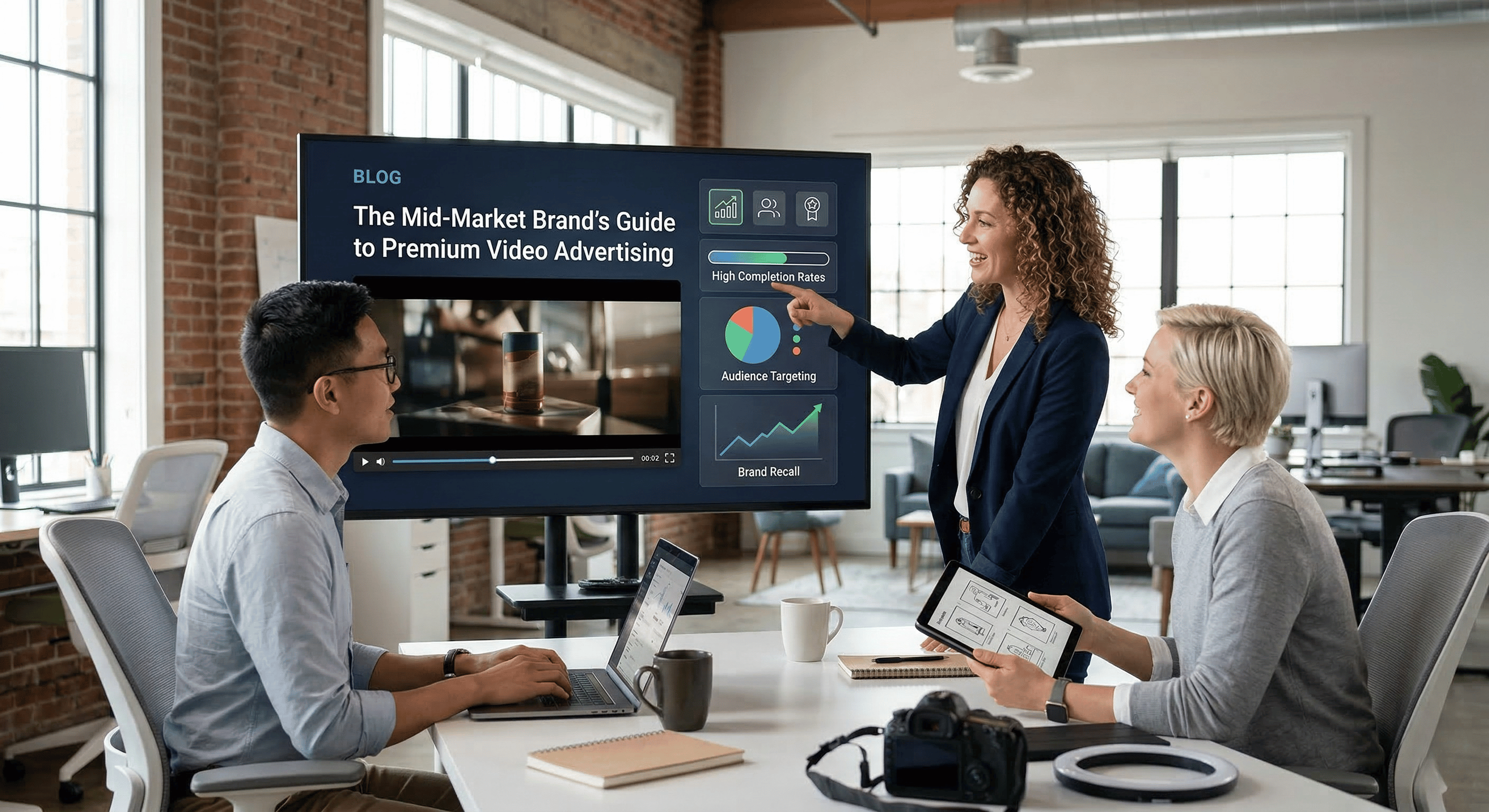
The Mid-Market Brand's Guide to Premium Video Advertising
TL;DR
Mid-market brands - those spending $5,000 to $100,000 per month on digital advertising - are systematically locked out of premium video inventory. The barriers are threefold: (1) premium publishers like The New York Times and Forbes prioritize high-budget advertisers, (2) agencies charge retainers of $2,500 to $15,000+ per month just to manage campaigns, and (3) DSPs (demand-side platforms) require technical expertise and minimum spends that mid-sized budgets cannot support. The result is a choice between low-quality programmatic exchanges or giving up on premium placements entirely. Attention as a Service (AaaS) solves this by offering subscription-based access to premium completed views at fixed prices - no agency, no DSP, no gatekeeping.
The premium inventory access problem: why big publishers favor big budgets
Premium publishers - think The New York Times, The Independent, Wall Street Journal, Vogue, and The Atlantic - offer what mid-market brands desperately want: brand-safe, high-attention environments with engaged, affluent audiences.
The New York Times attracts over 150 million monthly readers. According to December 2025 data, visitors to NYT spend an average of 7 minutes per session - far above industry norms. The publication's Q4 2024 digital advertising revenue grew 25% year-over-year to $147.2 million, driven by increased marketer demand and improved ad performance.
Forbes reaches influential leaders and growing business owners. Wall Street Journal boasts that 70% of America's C-suite is within its readership. These are not mass-market placements. They are high-value, high-intent audiences - exactly the kind that drive brand perception and consideration at the upper and mid-funnel.
But here is the problem: premium publishers are not designed for mid-market budgets.
Why publishers prioritize large advertisers
Premium inventory is finite. The New York Times can only serve so many video ads per reader per day before user experience degrades. Forbes cannot infinitely expand inventory without diluting its editorial brand.
Because supply is limited, publishers allocate inventory based on deal size and relationship strength. A brand spending $500,000 annually gets priority access, dedicated account management, and premium placements. A brand spending $5,000 per month does not.
This is not because mid-market brands are less valuable. It is because the publisher's business model is built around large, stable relationships that can sustain dedicated sales teams and custom integrations.
The direct deal barrier
The New York Times, Forbes, and similar publishers primarily sell premium inventory through direct deals - programmatic guaranteed (PG) and private marketplace (PMP) arrangements negotiated between the advertiser (or their agency) and the publisher's sales team.
These deals typically require:
- Minimum quarterly or annual commitments - often $50,000 to $250,000+
- Advance payment or insertion order (IO) agreements - locking in spend months ahead
- Relationship management - ongoing communication between agency trading desks and publisher account teams
For enterprise brands, this is standard operating procedure. For a mid-market brand with a $20,000 monthly budget, it is an impossible ask.
What is left: the open exchange
Mid-market brands that cannot access direct deals are pushed to the open programmatic exchange - the spot market for unsold, remnant, and non-premium inventory.
The open exchange is not inherently bad. It offers scale and targeting flexibility. But it is also where you find:
- Made-for-advertising (MFA) sites: low-quality content farms designed purely to generate ad revenue
- Viewability issues: ads that load but are never seen
- Brand safety risks: placements next to questionable content
- Lower completion rates: environments where viewers are less engaged
According to the ANA's 2025 Programmatic Transparency Benchmark, only $439 of every $1,000 spent programmatically reaches actual consumers. The rest is absorbed by intermediary fees, non-viewable impressions, and low-quality inventory.
In short: mid-market brands either pay premium prices for direct access they cannot afford, or they settle for open-exchange inventory that wastes their budget.
The agency trap: paying for hours, not outcomes
Let's say a mid-market brand decides they want help accessing premium inventory. The natural move is to hire a digital marketing agency.
Agencies promise expertise, industry relationships, and the technical know-how to navigate programmatic buying. What they deliver - often at great cost - is time and effort, not guaranteed results.
How agencies charge
Most agencies operate on one of three pricing models:
1. Monthly retainer
The most common model. The client pays a fixed monthly fee for ongoing services - strategy, campaign setup, optimization, reporting, and account management.
According to 2025 industry data:
- General marketing agencies charge $2,500 to $10,000 per month for small to mid-sized businesses
- Full-service digital agencies charge $5,000 to $15,000+ per month for comprehensive campaigns
- Specialized video or programmatic agencies charge $7,500 to $25,000+ per month for enterprise clients
For a mid-market brand with a $10,000 monthly advertising budget, a $5,000 agency retainer means half the budget goes to management fees before a single ad is served.
2. Percentage of ad spend
Some agencies charge 10% to 30% of total media spend as their fee. This sounds more reasonable - until you realize that an agency is incentivized to increase spend, not to increase efficiency.
If you are spending $10,000 per month on ads and the agency charges 15%, that is $1,500 in fees. If they recommend increasing spend to $20,000, their fee doubles to $3,000 - whether or not your results improve.
3. Performance-based fees
A small minority of agencies tie fees to business outcomes like conversions or revenue. This sounds ideal, but attribution is messy. Most platforms cannot accurately credit individual channels, making it difficult to determine what the agency actually contributed.
And even when performance-based models exist, they still require a base retainer to cover the agency's costs.
What you are actually paying for
When you hire an agency, here is what you are buying:
- Strategy and planning: deciding which platforms, formats, and audiences to target
- Campaign setup: creating campaigns in DSPs, uploading creative, configuring targeting
- Optimization: adjusting bids, budgets, and creative based on performance
- Reporting: pulling data and presenting results in monthly or weekly updates
- Account management: being available for calls, questions, and revisions
This is valuable work. But it is labor, not outcomes. You are paying for the agency's time and expertise, not for completed video views or verified attention.
If the campaign underperforms - if completion rates are low, if CPMs spike, if inventory turns out to be low-quality - you still pay the retainer. The agency is compensated for effort, not results.
The relationship tax
Agencies also add a relationship layer to media buying. They sit between you and the inventory you want to access.
- Want to negotiate a deal with The New York Times? The agency will handle it - but they will take a cut.
- Want to adjust targeting mid-campaign? You email your account manager, who emails the media buyer, who makes the change.
- Want to understand why your CPMs increased 40% in November? You wait for the monthly report.
For enterprise brands with $2 million+ annual budgets, this overhead is justified. The agency provides strategic value, negotiates better rates at scale, and manages complexity across dozens of campaigns.
For mid-market brands, it is simply too expensive. You are paying for infrastructure you do not fully need, in exchange for access you still cannot afford.
DSP complexity: why self-serve programmatic is not really self-serve
Some mid-market brands skip the agency and attempt to buy premium inventory directly through a DSP - a demand-side platform like Google's Display & Video 360 (DV360), The Trade Desk, StackAdapt, or Amazon DSP.
DSPs promise self-serve media buying: you log into the platform, set your budget, configure your targeting, upload your creative, and launch your campaign. In theory, you gain the same access to premium inventory that agencies have, without paying the agency fee.
In practice, DSPs are enterprise-grade tools designed for professional media buyers, not for small teams without programmatic expertise.
The learning curve problem
DSPs are powerful, but they are not intuitive. Here is what you need to understand before you can run a campaign effectively on platforms like DV360 or The Trade Desk:
- Real-time bidding (RTB) mechanics: how auctions work, how bid shading functions, how to set floor prices
- Targeting hierarchies: the difference between contextual, behavioral, demographic, and lookalike targeting
- Frequency capping: how to prevent the same user from seeing your ad too many times
- Attribution models: how to credit conversions across multiple touchpoints
- Creative specifications: the exact formats, sizes, and file types required for each placement
- Reporting structures: how to build custom dashboards and export data for analysis
According to user reviews on G2, The Trade Desk has a "steep learning curve" that requires "training investment" and is "best suited for experienced traders." DV360 is described as "enterprise-grade" and "requiring higher spend thresholds" with "granular control over bidding, frequency, and inventory sources."
These are not platforms you can master in a weekend. They are professional tools that require weeks or months of practice to use effectively.
The minimum spend barrier
Most DSPs also enforce minimum spend thresholds - either explicit or implicit - that exclude smaller budgets.
- The Trade Desk: Known for "high minimum spends" according to industry sources. Unofficial reports suggest monthly minimums of $50,000+, though this varies by partnership.
- Amazon DSP: Minimum spend is typically $35,000+ for self-serve access. Managed service options exist but come with agency-like fees.
- DV360: No official public minimum, but the platform is designed for "large brands, agencies, and full-funnel e-commerce" according to marketing literature. Small accounts receive limited support.
- StackAdapt: More accessible to mid-market advertisers, with minimums around $5,000+ per month - but still a significant commitment.
Even when you meet the minimum, there is no guarantee of premium inventory access. DSPs connect to ad exchanges and SSPs (supply-side platforms), but premium publishers often reserve their best placements for direct deals and PMPs that require pre-negotiation.
The technical support gap
Enterprise advertisers get dedicated account managers, onboarding support, and strategic guidance. Mid-market advertisers using DSPs self-serve often get… a help center and a ticketing system.
When something goes wrong - a campaign does not spend, targeting does not work as expected, reporting is incomplete - you are on your own to troubleshoot it. And if you are not an experienced programmatic buyer, you may not even know what questions to ask.
What mid-market brands actually need: predictable cost, premium placements, zero setup friction
Let's step back and ask: What does a mid-market brand actually want from video advertising?
The answer is simpler than the current ecosystem makes it seem.
1. Access to premium, brand-safe inventory
Mid-market brands want their video ads to appear in environments that enhance their brand - publications like The New York Times, Forbes, Vogue. Not made-for-advertising sites. Not low-quality content farms. Not placements they would be embarrassed to show their board.
2. Predictable, fixed pricing
Mid-market brands need to plan budgets quarterly or annually. Auction-based CPM pricing that spikes 70% in Q4 and crashes 30% in January makes planning impossible. They want to know, in advance, what each unit of attention will cost.
3. Outcome-based guarantees
Mid-market brands do not want to pay for impressions that may never be seen. They want to pay for completed views - ads that were actually watched from start to finish by real people.
4. Zero technical complexity
Mid-market brands do not have programmatic traders on staff. They do not want to spend weeks learning DSP interfaces, debugging targeting bugs, or deciphering attribution reports. They want a solution that works out of the box.
5. No agency overhead
Mid-market brands cannot afford to spend $5,000 to $15,000 per month on management fees. They need direct access to inventory at a price that makes sense for their budget.
The current ecosystem - agencies, DSPs, and direct publisher deals - was not built to deliver all five of these requirements simultaneously. It was built for enterprise budgets that can absorb complexity and overhead.
How a subscription model changes the equation
This is where Attention as a Service (AaaS) offers a fundamentally different approach.
AaaS platforms like VISTY operate on a subscription model. Instead of bidding in auctions, negotiating with publishers, or hiring agencies to do it for you, you simply:
- Choose a monthly budget (e.g., $5,000 per month)
- Pay a fixed price per completed view (e.g., $0.05 per CPCV)
- Receive guaranteed completed views on premium inventory (e.g., 100,000 completed views)
There is no auction. No bidding war. No Q4 price spike. No agency retainer. No DSP setup. No wondering whether your ads were actually seen.
You pay for attention that has already been delivered - verified, completed video views on brand-safe, premium placements.
Why the subscription model works for mid-market brands
Predictability: You know exactly what you will spend and exactly what you will receive. No surprise fees. No volatility. No waste.
Accessibility: There are no minimums that lock you out. A $2,000 monthly budget works the same way as a $20,000 budget - you just receive proportionally fewer completed views.
Simplicity: No technical setup. No DSP training. No campaign optimization. You set your budget, and VISTY delivers the views.
Premium access: You gain direct access to the same high-quality inventory that enterprise brands pay agencies to negotiate - without the agency layer.
Outcome guarantee: You only pay for completed views. Not impressions. Not partial views. Full, start-to-finish attention.
This is infrastructure thinking applied to advertising. Just as you would not hire an agency to manage your email software or your project management tool, you should not need an agency to access premium video advertising. It should work as a utility: predictable, reliable, and subscription-based.
Real scenario: what $5,000/month looks like under CPM vs AaaS
Let's make this concrete. Imagine you are a mid-market brand with a $5,000 monthly budget for video advertising. Here is what that budget actually delivers under each model.
Scenario A: Non-transparent DSP
You set up a campaign on a mid-market programmatic platform. The interface is clean. The dashboard shows "reach" and "impressions." The CPM looks reasonable - maybe $8–$12. You launch the campaign and wait for results.
Here is what actually happens to your $5,000:
Step 1: Platform margin (the hidden tax)
Most mid-market DSPs operate on a model where they take a margin on your spend. They do not disclose this fee transparently - it is baked into the pricing.
Industry estimates suggest these platforms take 40–60% of your budget as margin before a single dollar reaches actual media.
Let's use 50% as a conservative estimate:
- Your budget: $5,000
- Platform margin (50%): $2,500
- Working media budget: $2,500
Step 2: What the $2,500 working media budget actually buys
The remaining $2,500 goes into the programmatic open exchange - the spot market for unsold, remnant, and non-premium inventory. Here is where your "reach" comes from:
Inventory breakdown (based on industry waterfall data):
- 60–70% low-quality inventory: Made-for-advertising (MFA) sites, banner video placements (in-banner video units that autoplay muted in tiny 300×250 slots), below-the-fold placements, apps with fraudulent traffic
- 20–30% mid-tier inventory: Legitimate but non-premium publishers, aggregator sites, content farms
- 10% or less premium inventory: Actual brand-safe, high-attention placements
Let's be generous and say 30% of your working budget goes to decent inventory:
- Working media budget: $2,500
- Low-quality inventory (70%): $1,750
- Legitimate inventory (30%): $750
Step 3: Viewability and attention waste
Even the "legitimate" $750 in inventory suffers from the same issues that plague CPM buying:
- Viewability rate: ~70% (30% of ads never enter the viewport)
- Attention rate: ~30% of viewable ads are actually viewed (Lumen data)
- Completion rate: ~64% of viewed ads are watched to the end
So from your original $5,000:
- Platform margin: $2,500 (never reaches media)
- Low-quality inventory: $1,750 (impressions on MFA sites, in-banner video, fraud)
- Legitimate inventory: $750
- Viewable: $750 × 70% = $525
- Actually viewed: $525 × 30% = $157.50
- Completed: $157.50 × 64% = ~$101 worth of actual attention
The math:
At an $8 CPM on the $2,500 working budget:
- Total impressions: 312,500
- Viewable impressions (70%): 218,750
- Actually viewed (30% of viewable): 65,625
- Completed views (64% of viewed): ~42,000 completed views
Effective CPCV: $5,000 ÷ 42,000 = $0.119 per completed view
But wait—it gets worse:
- ~70% of those "completed views" came from low-quality inventory (MFA sites, in-banner video units that no one actually watched, bot traffic)
- The remaining 30% (~12,600 completed views) came from legitimate placements
Real completed views on legitimate inventory: ~12,600
True CPCV for attention that matters: $5,000 ÷ 12,600 = $0.397
And you have no transparency into any of this. The dashboard shows "312,500 impressions delivered" and calls it a success.
Scenario B: Attention as a Service (VISTY)
Setup:
- Monthly budget: $5,000
- Fixed CPCV: $0.05 per completed view
- Completed views delivered: 100,000 completed views
What actually happens:
VISTY operates on a transparent subscription model with a service fee built into the CPCV pricing. Unlike hidden platform margins that range from 40–60%, VISTY's pricing is clear upfront: you pay $0.05 per completed view, and that's the price - no auction volatility, no surprise fees.
The key difference: every view is completed, premium, and verified. You're not paying for impressions that may never be seen or inventory that turns out to be low-quality MFA sites.
Outcome:
- 100% of completed views are on premium inventory (The New York Times, Forbes, Vogue - verified, brand-safe placements)
- 100% of views are completed (no partial views, no unseen ads)
- Price is locked (no Q4 spikes, no volatility)
- Full transparency (you know exactly where your ads run and what you're paying per view)
The comparison
The reality check
With the non-transparent DSP:
- You spent $5,000
- $2,500 never reached media (platform margin)
- $1,750 went to junk inventory (MFA sites, in-banner video, fraud)
- $750 went to legitimate inventory
- You received ~12,600 completed views on placements that actually matter
- You paid $0.397 per completed view for attention on legitimate inventory
With VISTY (AaaS):
- You spent $5,000
- You received 100,000 completed views at a transparent, fixed $0.05 CPCV
- 100% of views are on premium inventory (The New York Times, Forbes, Vogue)
- You paid $0.05 per completed view for guaranteed attention on premium placements
That's 8x more completed views on premium inventory, at 13% of the cost per view.
The difference is not subtle. One model hides where your money goes and buries most of it in margins and waste. The other gives you transparent pricing and guaranteed premium delivery.
Making the case for Attention as a Service
Mid-market brands have been forced to choose between three bad options for too long:
- Pay agencies to manage campaigns, burning half the budget on retainers
- Learn DSPs and hope you can compete for premium inventory in real-time auctions
- Settle for low-quality inventory on the open exchange and accept the waste
Attention as a Service creates a fourth option: fixed-price, subscription-based access to premium completed views, without the gatekeeping.
No bidding. No agencies. No DSPs. No complexity. Just attention, delivered as infrastructure.
Frequently Asked Questions
What makes a brand "mid-market" in digital advertising?
Mid-market brands typically have monthly digital advertising budgets between $2,000 and $50,000. They are large enough to invest meaningfully in paid media but small enough that enterprise-level solutions (agencies, DSPs, direct publisher deals) are cost-prohibitive. Examples include regional e-commerce brands, growing SaaS companies, professional services firms, and D2C brands scaling beyond early-stage funding.
Why can't mid-market brands just buy premium inventory directly from publishers?
Premium publishers like The New York Times and Forbes prioritize relationships with large advertisers who can commit to quarterly or annual spend minimums - often $50,000 to $250,000+. They allocate inventory based on deal size and relationship strength. Mid-market brands that cannot meet these minimums are excluded from direct deals and pushed to the open programmatic exchange, where inventory quality is lower.
How much do marketing agencies actually charge?
According to 2025 industry data, most agencies charge monthly retainers ranging from $2,500 to $15,000 for mid-market clients. Full-service digital agencies charge $5,000 to $10,000 per month for small to mid-sized businesses. Specialized agencies (SEO, PPC, video) charge $7,500 to $25,000+ per month. Some agencies also charge 10% to 30% of ad spend as a management fee on top of the retainer. For a brand spending $10,000/month on ads, total agency costs can range from $3,500 to $8,000+ per month.
Are DSPs like DV360 and The Trade Desk designed for small teams?
No. DV360 and The Trade Desk are enterprise-grade platforms designed for professional media buyers, large agencies, and brands with significant programmatic expertise. User reviews describe steep learning curves, high minimum spends, and complexity that requires dedicated training. DV360 is described as ideal for "large brands, agencies, and full-funnel e-commerce." The Trade Desk has "high minimum spends" and is "best suited for experienced traders." Mid-market teams without programmatic expertise often struggle to use these platforms effectively.
What is the typical minimum spend for a DSP?
Minimums vary by platform. The Trade Desk reportedly requires $50,000+ per month, though this is not publicly disclosed. Amazon DSP has a $35,000+ minimum for self-serve access. StackAdapt is more accessible at $5,000+ per month (depending on whether you are self-serve or managed service). DV360 has no official minimum, but the platform is designed for enterprise budgets and offers limited support for small accounts. Even when you meet the minimum, premium inventory access is not guaranteed without pre-negotiated deals.
How does Attention as a Service (AaaS) differ from programmatic buying?
Programmatic buying uses real-time auctions (RTB) where advertisers bid on impressions. Prices fluctuate based on competition, and there is no guarantee the ad will be seen. AaaS replaces the auction with a fixed-price, subscription model. You pay a set price per completed view - not per impression. The price is locked in advance, there is no bidding, and you only pay when the ad was watched to completion. It is outcome-based buying instead of opportunity-based buying.
Can mid-market brands access premium publishers like The New York Times through AaaS?
Yes. That is the core value proposition. AaaS platforms like VISTY connect mid-market brands directly to completed views on premium inventory - The New York Times, Forbes, Vogue - without requiring the agency relationships, direct deals, or high minimums that traditionally gatekeep access. You pay the same fixed CPCV whether you are spending $2,000 or $20,000 per month.
Is AaaS only for video advertising?
Currently, yes. AaaS is built around Cost Per Completed View (CPCV), which is a video-specific metric. The model guarantees that video ads are watched from start to finish. For non-video campaigns, other outcome-based metrics exist (CPC, CPA, CPE), but the subscription-based, fixed-price infrastructure model is best suited to video at this stage.
How do I know if AaaS is right for my brand?
AaaS is a good fit if you: (1) want access to premium video inventory but cannot afford agency retainers or DSP complexity, (2) need predictable costs for budget planning, (3) prefer to pay for outcomes (completed views) rather than opportunities (impressions), (4) have a monthly video advertising budget between $2,000 and $50,000, and (5) want to avoid the waste and volatility of CPM buying. If those describe your situation, AaaS is worth exploring.
Last updated: March 2026
